How AI really powers social media automation for marketers
Discover the true role of AI in social media automation. Enhance your marketing strategy by learning how AI can boost productivity and engagement.

Most social media marketers assume AI either does everything or is just a fancy scheduling button with a chatbot attached. Neither is true. 87% of marketers report improved productivity after adopting AI-driven content tools, yet the gap between expectation and real-world results is still enormous. The truth is messier and more interesting: AI handles the repetitive, time-consuming grunt work of content distribution better than any human team can, but it needs your strategic thinking and brand voice to actually perform. This guide breaks down what AI-driven automation does well, where humans remain essential, and how to build a workflow that gets results.
Table of Contents
- What is AI-driven social media automation?
- How AI transforms social content creation and distribution
- Limits, risks, and human oversight required
- Best practices for responsible and effective AI automation
- AI is a multiplier, not a replacement: What most guides miss
- Streamline your social media with Status 200 Uploads
- Frequently asked questions
Key Takeaways
| Point | Details |
|---|---|
| AI accelerates workflows | Marketers and small teams see major time savings when AI handles repetitive social media tasks. |
| Human oversight is crucial | Automation boosts efficiency, but brand voice and compliance require manual review and editing. |
| Maximize value, minimize risk | The right mix of AI-driven tools and human creativity leads to the best social content outcomes. |
| Best practices prevent pitfalls | Stay on top of compliance and engagement by combining automation with regular human audits. |
What is AI-driven social media automation?
AI-driven social media automation is not the same as setting up a post to go live at 9 a.m. on Tuesday. That is rule-based scheduling, and it has existed for over a decade. True AI automation uses machine learning and natural language processing (NLP) to make decisions, adapt content for different platforms, and learn from performance data over time.
Here is a clear breakdown of what separates AI-driven tools from traditional rule-based scheduling:
| Feature | AI-driven | Rule-based |
|---|---|---|
| Caption generation | Yes, using NLP | No |
| Platform format adaptation | Automatic | Manual or template-based |
| Optimal posting time prediction | Yes, data-driven | Fixed schedule |
| Content performance learning | Continuous | None |
| Image/video suggestions | Yes | No |
| Voice-to-post transcription | Yes | No |
The real shift with AI is in adaptive automation. Instead of executing fixed instructions, AI tools analyze what works, adjust what gets published, and surface insights you would have spent hours digging up manually. For example, voice-to-post transcription using tools like Make and ChatGPT can transform a quick audio note into fully optimized captions for Instagram, LinkedIn, and TikTok at the same time.
Common AI-powered workflow examples include:
- Voice-to-post: Record a thought, AI transcribes and rewrites it as platform-ready copy
- Content curation: AI scans RSS feeds or trending topics and queues relevant posts
- Smart reposting: AI identifies top-performing old content and reschedules it strategically
- Hashtag and alt-text generation: AI writes these automatically based on image and content analysis
Understanding these capabilities is the first step toward optimizing social media posting in a way that actually scales.
Pro Tip: AI can draft strong captions fast, but your brand voice is not something a model can fully replicate. Always review AI outputs before publishing to make sure the tone matches your audience.
How AI transforms social content creation and distribution
Now that you know what true AI automation offers, let’s look at exactly how it upgrades everyday content operations and the metrics that matter.
“AI lets you focus on creative direction, not copy-pasting.”
That quote captures the real promise. According to research on content marketing automation, teams save 40-70% of content creation time monthly. For a five-person marketing team managing five social accounts, that translates to roughly 28 hours saved per month. At typical agency billing rates, that is a meaningful return. The same research shows 4 to 8x ROI on tools priced between $249 and $499 per month when automation is used correctly.
Here is a practical numbered workflow that a small team can implement right now:
- AI-powered ideation: Use an AI content tool to generate topic ideas based on trending keywords, competitor gaps, or audience questions
- Caption drafting: Feed your core message into an AI model to generate platform-specific variations for Instagram, LinkedIn, and TikTok
- Image selection: Use AI-powered media tools to suggest or generate visuals that match the tone and content of each post
- Smart scheduling: Let an AI scheduler analyze your historical engagement data and pick optimal posting windows for each platform
- Analytics review: Use AI-generated reports to surface what performed, what flopped, and what to repeat
This five-step workflow replaces what used to take a team member most of their week. The key is that humans still own steps one and three in terms of final approval, but the time spent generating options drops dramatically.
Streamlining multi-platform posting is especially valuable here. A single piece of long-form content, like a blog post or podcast episode, can be broken into platform-adapted snippets, scheduled across six platforms, and tracked through one dashboard without a single copy-paste action.

Pro Tip: Use automation for distribution and scheduling, not for replying to comments or engaging with followers directly. Authentic human responses in comment sections still drive far better community trust and retention than any automated reply system.
Automating posting times alone can lift engagement by a meaningful margin when the AI is pulling from real audience activity data rather than generic best-practice windows.
Limits, risks, and human oversight required
Having explored the strengths, it is vital to understand where AI falls short. Because it does fall short, and pretending otherwise will cost you.
Research tracking content performance over 16 months found that pure AI content ranks 23-31% lower in Google search results than human-edited content. The same study found that 41% of AI-generated content needs significant revision before it is ready for publication, primarily due to brand voice inconsistency and factual vagueness.
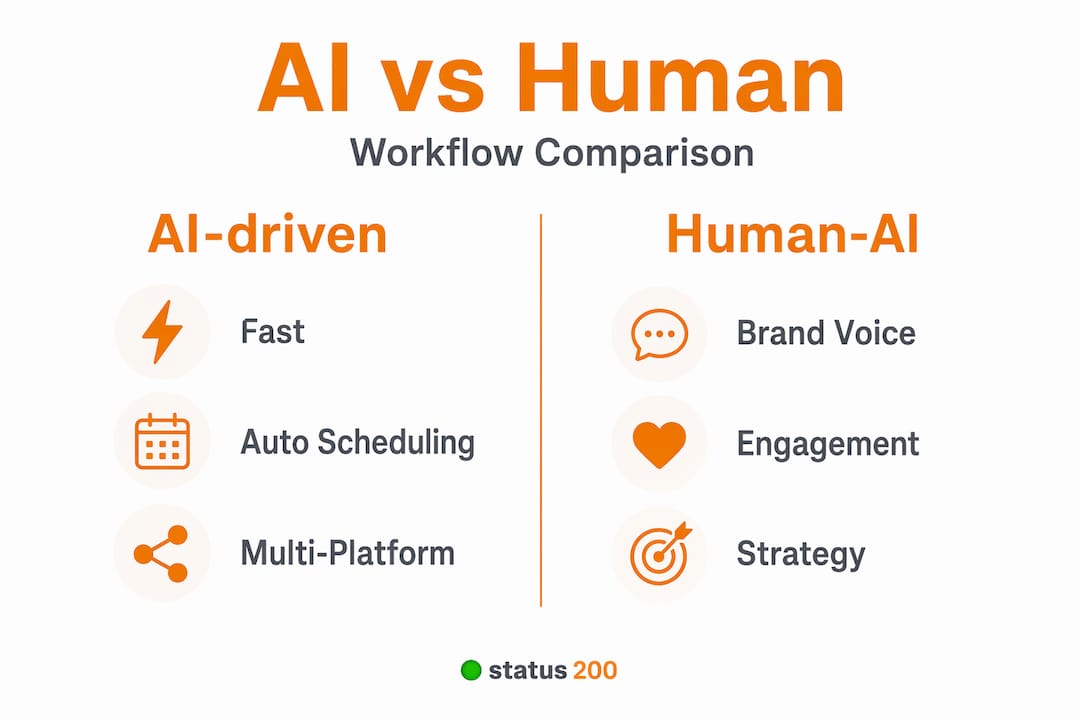
Here is a side-by-side comparison of what changes when you add human oversight:
| Dimension | Pure AI workflow | Human-AI collaboration |
|---|---|---|
| Speed | Very fast | Slightly slower |
| Engagement rate | Often below average | Significantly higher |
| Brand consistency | Inconsistent | Reliable |
| Compliance risk | High | Managed |
| SEO performance | 23-31% lower | Competitive |
| Creative originality | Generic | Differentiated |
The risks extend beyond just engagement. Over-automation creates patterns that platform algorithms can detect and penalize. Posting the same format, at the same intervals, with similar caption structures signals inauthentic behavior. Some platforms have moved to restrict accounts exhibiting these patterns.
There is also the regulatory dimension. The EU AI Act now requires explainability for high-risk AI applications, and brands operating in multiple regions need documented workflows to demonstrate compliance. Even in the U.S., FTC guidelines on automated content and disclosure are tightening.
Common risks to watch for:
- Brand voice drift: AI picks up generic internet tone, not your specific voice
- Over-automation penalties: Platform detection of repetitive content patterns
- Compliance blind spots: Regional laws around AI-generated content and disclosure
- Fact errors: AI confidently states incorrect information if not checked
“Agentic AI brings power but demands constant human review for best ROI.”
Understanding manual vs automated posting trade-offs helps you make smarter decisions about which tasks to automate and which to keep under direct human control.
Best practices for responsible and effective AI automation
To help you move from insight to action, here is how savvy SMB marketers are putting AI to work without falling into the common traps.
Gartner predicts that 60% of brands will use agentic AI for one-to-one customer interactions by 2028. That is not a distant future trend. It is a signal that the automation landscape is accelerating fast, and the brands building responsible frameworks now will have a serious competitive edge.
Follow this numbered approach to keep your AI automation safe and effective:
- Always review AI drafts before publishing. Even a 90-second scan catches tone problems, factual errors, and off-brand language
- Set platform posting limits. Cap daily posts per account to avoid triggering pattern detection algorithms
- Document your compliance steps. Keep a simple internal log of how AI is used in your content workflow, especially for regulated industries
- Localize content manually when targeting new regions. AI often misses cultural nuance, slang, and compliance requirements in non-English markets
- Run weekly AI audits. Review a sample of published AI-assisted posts for bias, off-brand tone, or any content that could create legal exposure
Quick wins you can implement this week:
- Batch-schedule a full week of posts in one session using AI-assisted copy and scheduling
- Use AI to adapt time zones automatically for global audience segments
- Generate captions in multiple tones (professional, casual, witty) and pick the best fit per platform
Critical don’ts to avoid:
- Do not automate comment replies or DMs at scale. It reads as robotic and damages community trust
- Do not publish AI-generated news or opinion content without fact-checking. Errors spread fast and hurt credibility
- Do not use AI to mass-follow or mass-unfollow accounts. This violates platform terms of service universally
Connecting these practices to content publishing best practices and platform-specific posting strategies will help you tailor your automation approach to each channel rather than applying a one-size-fits-all strategy.
Pro Tip: Automate your distribution pipeline completely. But when someone engages with your post, make sure a real human reads and responds. That combination of automation plus authentic engagement is what separates growing accounts from stagnant ones.
AI is a multiplier, not a replacement: What most guides miss
Here is what most AI-in-marketing articles skip over: the brands seeing the biggest gains from automation are not using AI to replace their creative teams. They are using it to make those teams disproportionately more effective.
Most marketers overestimate what AI can do solo. The fantasy is a tool that generates, schedules, posts, analyzes, and optimizes without human input. The reality is that AI tools trained on massive datasets still produce content that feels generically internet-brained unless a skilled human shapes the inputs, reviews the outputs, and injects genuine brand perspective. Research consistently shows that pure AI content underperforms in SEO and engagement compared to work where humans remain in the loop.
The real competitive advantage is not “we use AI.” It is “we use AI so our team can spend more time on strategy, community building, and creative decisions that machines cannot replicate.”
Think about what your best content strategist actually does that AI cannot: they understand your customers’ unspoken frustrations, they recognize a cultural moment that is perfect for your brand to respond to, they know which topics to avoid because of a conversation that happened in a client call last Tuesday. That knowledge has no prompt that extracts it automatically.
Agentic AI, the next generation of tools that take sequences of actions autonomously, is genuinely exciting. But treating it as an autopilot for all tasks is a fast path to off-brand posts, compliance problems, and disengaged audiences. Use it as an amplifier. Point it at the tasks that drain your team’s creative energy, and redirect that saved energy toward work that actually differentiates your brand.
The brands that will win the next few years are not those with the most aggressive automation. They are the ones building thoughtful social media engagement strategies that use AI for scale and humans for depth. And the ones investing in optimizing reach strategies that combine both intelligently rather than treating automation as a shortcut.
Streamline your social media with Status 200 Uploads
The strategies in this guide work best when you have a platform built to support them. Status 200 Uploads brings together multi-platform posting, smart scheduling, media management, and workflow automation through a single, clean dashboard.
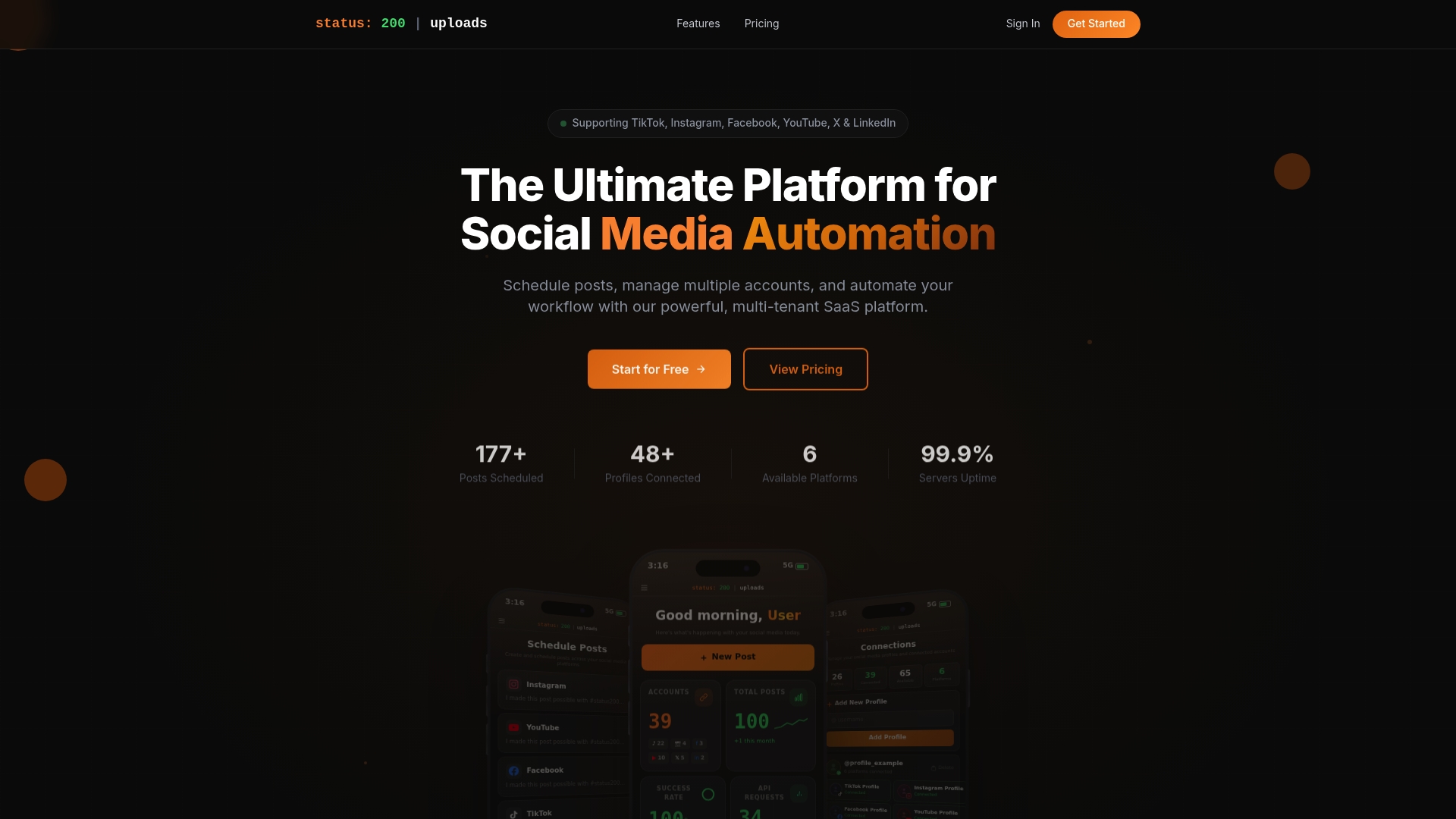
Whether you are managing five accounts or fifty, Status 200 Uploads gives your team the infrastructure to apply every best practice covered here without stitching together five separate tools. You can publish to TikTok, Instagram, Facebook, YouTube, X, and LinkedIn simultaneously, connect automation workflows through Zapier or Make.com, and track post performance all in one place. If you are evaluating your current tool stack, the Status 200 Uploads vs Publer comparison is a practical starting point for understanding where the platform stands on features that matter most to SMB marketers.
Frequently asked questions
How does AI-generated content impact SEO and engagement results?
AI-generated content typically ranks 23-31% lower than human-edited posts in search results, and 41% requires significant editing before it meets brand voice standards for strong engagement.
Can AI handle compliance and localization for every region?
Not fully. Regional compliance edits and localization nuances still require manual review, and over-automation can trigger platform bans or run into restrictions under regulations like the EU AI Act.
What types of tasks does AI automate best in social media?
AI performs best at drafting captions, scheduling posts, adapting formats per platform, and handling multi-platform distribution. Voice-to-post transcription workflows using tools like Make and ChatGPT are particularly strong examples of this capability.
How much time can teams actually save with AI automation?
Small teams typically save around 28 hours per month when automating content creation and scheduling, with overall time savings ranging from 40 to 70% and ROI of 4 to 8x on mid-tier tools.