Manual vs Automated Posting: Best Workflow in 2026
Manual vs automated posting: discover which workflow drives more engagement, fewer risks, and better results for your SMB social media strategy in 2026.

Most social media managers assume automation is the gold standard for posting efficiency. But that assumption deserves a hard look. Recent experiments show that manual posts can generate 2-3x more impressions and 50-70% higher engagement compared to scheduled posts in certain scenarios. That’s not a small gap. It raises a real question: are you trading performance for convenience? This article breaks down both approaches, compares their real-world impact on engagement and efficiency, and gives you a practical framework for deciding which method, or combination of methods, fits your business goals.
Table of Contents
- Understanding manual and automated posting
- Comparing engagement and efficiency
- Drawbacks and risks for SMBs
- Making the right choice: Practical guidelines
- A fresh perspective: Combining approaches for optimal results
- Take your posting strategy further with tools
- Frequently asked questions
Key Takeaways
| Point | Details |
|---|---|
| Manual boosts engagement | Manual posts are often favored by algorithms and can generate higher impressions and engagement in certain scenarios. |
| Automation enables scaling | Automated posting streamlines workflow and is essential for SMBs needing to scale content output efficiently. |
| Each has trade-offs | Manual is time-consuming and requires hands-on effort, while automation can introduce glitches and less personalization. |
| Blended workflow is best | Combining manual and automated posting delivers optimal results for SMB campaigns seeking both efficiency and engagement. |
Understanding manual and automated posting
Before comparing results, it helps to be clear on what each method actually involves day-to-day.
Manual posting means you log into each social media platform, write or paste your content, upload your media, and hit publish yourself. Every step is hands-on. You control the timing, the copy, and the format in real time. This approach works especially well for campaigns that require a personal touch, like responding to a trending topic, launching a product with a live feel, or posting content that needs to match a specific moment.
Automated posting uses a scheduling tool to plan and publish content ahead of time. You build your content calendar in advance, set your posting times, and the tool handles distribution. This is where platforms like schedule social posts come in, letting you manage multiple accounts and platforms from one dashboard without logging into each one manually.
Here’s a quick breakdown of when each method tends to show up in real workflows:
- Manual posting is common for high-stakes launches, real-time engagement, personalized campaigns, and crisis communication
- Automated posting is used for consistent content cadences, multi-platform distribution, evergreen content, and campaigns running across time zones
- Hybrid approaches combine both, using automation for volume and manual posting for moments that demand authenticity
One important caveat: automation can result in glitches, outdated content, and less personalization if it isn’t actively monitored. Scheduling a post is not the same as managing a post.
Pro Tip: Use manual posting for personalized, high-engagement campaigns and automation for scaling your content volume. The two methods aren’t mutually exclusive.
Comparing engagement and efficiency
Understanding the basics is step one. Next, we compare how each posting method performs in real campaigns.
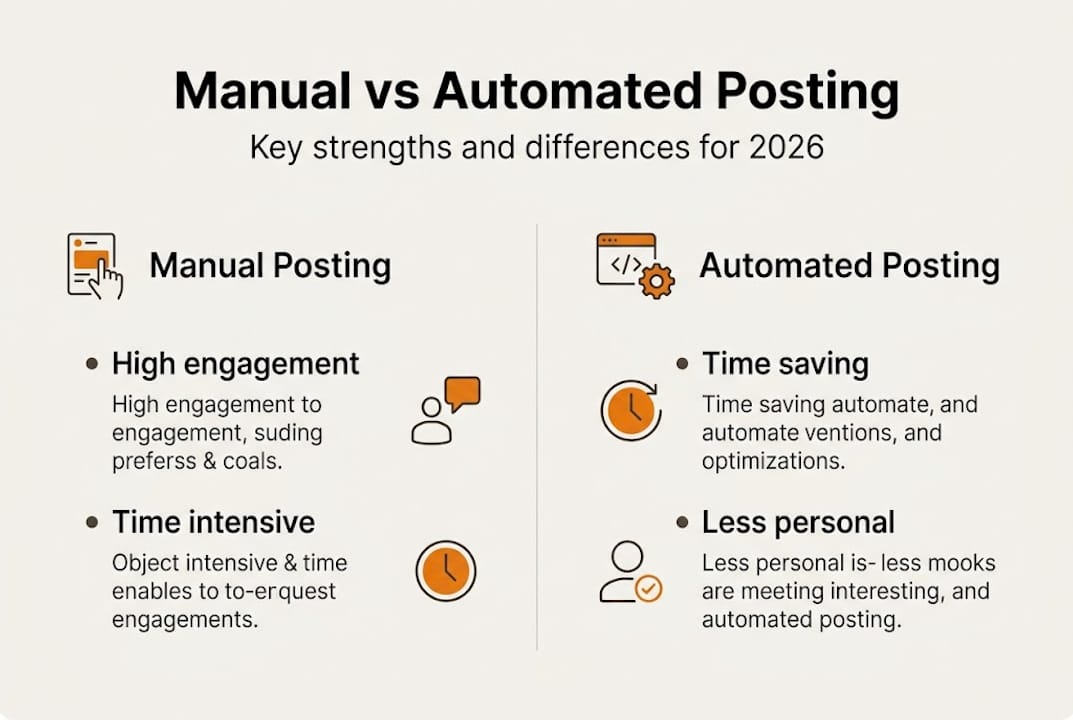
Engagement is where things get interesting. Algorithms may favor manual posts, boosting impressions and engagement in ways that scheduled content doesn’t always replicate. Platforms like Instagram and LinkedIn have been observed giving native, in-app posts a slight distribution advantage over third-party scheduled content. This isn’t guaranteed behavior, but it’s consistent enough to factor into your strategy.
“Manual posting, when timed well and published natively, can outperform automated content on reach and engagement, especially in the first hour after publishing.”
That said, automation wins on efficiency. A social media manager handling five platforms, three posts per day, would spend hours on manual publishing alone. Automation compresses that into a single planning session per week. The tradeoff is real.

Here’s a side-by-side comparison to make the differences concrete:
| Factor | Manual posting | Automated posting |
|---|---|---|
| Engagement rate | Higher in many cases | Moderate, varies by tool |
| Impressions | Often 2-3x higher | Consistent but lower |
| Time investment | High per post | Low after initial setup |
| Scalability | Poor at volume | Excellent |
| Personalization | Strong | Limited |
| Error risk | Low | Moderate (glitches, outdated posts) |
| Platform algorithm favor | Possible advantage | Neutral or slight disadvantage |
For SMBs managing lean teams, the efficiency argument for automation is hard to ignore. But if your engagement metrics are flat, it’s worth testing whether manual posting on your top-performing platform moves the needle. You can review social scheduler pricing to understand what automation tools cost relative to the time they save.
The honest answer is that neither method dominates across every metric. Manual posting wins on engagement. Automation wins on scale. Your job is to figure out which metric matters more for each campaign.
Drawbacks and risks for SMBs
After seeing performance comparisons, it’s vital to understand the risks and challenges each method poses for SMBs.
Small and medium-sized businesses face a specific set of constraints: limited staff, tight budgets, and pressure to maintain a consistent online presence. Both posting methods carry risks that hit harder when you don’t have a large team to absorb them.
Manual posting risks:
- Time drain: publishing manually across five platforms daily can consume two or more hours of a marketing manager’s day
- Inconsistency: missed posts, irregular timing, and human error become more likely without a system
- Burnout: repetitive manual tasks reduce bandwidth for higher-value creative and strategic work
- Scalability ceiling: manual posting fails at scale for SMBs, making growth harder to sustain without adding headcount
Automated posting risks:
- Glitches: scheduled posts can fail silently, especially during platform API changes or outages
- Outdated content: pre-scheduled posts may go live after a situation has changed, creating awkward or tone-deaf moments
- Less personalization: automated content often feels generic because it’s written in advance without real-time context
- Algorithmic friction: some platforms may deprioritize third-party published content in their distribution logic
For SMBs, the stakes of these risks are higher. A glitch that silently drops a product launch post isn’t just an inconvenience. It’s a missed revenue opportunity. A tone-deaf automated post during a news cycle can damage brand trust that took months to build. These aren’t hypothetical scenarios. They happen regularly to teams that set automation and forget it.
The key takeaway: both methods require active management. Automation reduces repetitive labor but doesn’t eliminate the need for oversight. Manual posting gives you control but costs time you may not have.
Making the right choice: Practical guidelines
With the main risks understood, let’s turn to practical steps for deciding which approach fits your goals.
Choosing between manual and automated posting isn’t a one-time decision. It should be revisited as your team size, content volume, and campaign goals evolve. Here’s a step-by-step framework to guide that decision:
- Define your campaign goal first. Are you trying to maximize engagement on a key launch, or maintain a steady content presence over 90 days? Engagement-focused campaigns benefit from manual posting. Consistency-focused campaigns benefit from automation.
- Audit your available resources. How many hours per week can your team realistically spend on social media publishing? If the honest answer is under five hours, automation is not optional. It’s necessary.
- Identify your top-performing platform. Focus manual effort where it has the most impact. If LinkedIn drives 70% of your leads, consider posting there manually while automating everything else.
- Set a monitoring cadence for automated content. Automation without oversight is where things go wrong. Build a daily five-minute check into your workflow to confirm scheduled posts published correctly.
- Test and measure. Run a four-week experiment: manual posts on one platform, automated on another. Compare engagement rates, reach, and click-through data. Let the numbers guide your next decision.
Manual posts may deliver higher engagement but are difficult to scale without automation tools. That’s why most high-performing SMB teams don’t choose one method exclusively. They use social post scheduling tools to handle volume and reserve manual effort for moments that genuinely benefit from it.
Pro Tip: Combine both methods by automating your evergreen and recurring content, then manually posting for product launches, trending topics, and community engagement moments. This hybrid approach gives you efficiency without sacrificing authenticity.
A fresh perspective: Combining approaches for optimal results
Most guides frame this as a binary choice: manual or automated. Pick one and commit. That framing is wrong, and it leads SMBs to underperform on both dimensions.
The highest-performing social media campaigns we’ve seen don’t choose sides. They treat manual and automated posting as tools in the same kit, each suited to different jobs. Automation handles the heavy lifting: consistent publishing, multi-platform distribution, and content that doesn’t require real-time judgment. Manual posting handles the moments that matter most, product launches, community responses, trending conversations, and anything where timing and tone need to be exactly right.
What surprises most teams when they try hybrid posting strategies is how much the manual posts benefit from the automated foundation. When your audience sees consistent content week after week, they’re more primed to engage when you show up with something personal and timely. The automation builds the relationship. The manual post deepens it.
Don’t let the either/or framing limit your strategy. Experiment with splitting your content calendar: automate 70-80% of your posts and keep 20-30% manual for high-value moments. Measure the results after 60 days. Most teams find that this split outperforms either method used exclusively.
Take your posting strategy further with tools
Bridging the gap between manual effort and automated scale is exactly what the right tool makes possible.
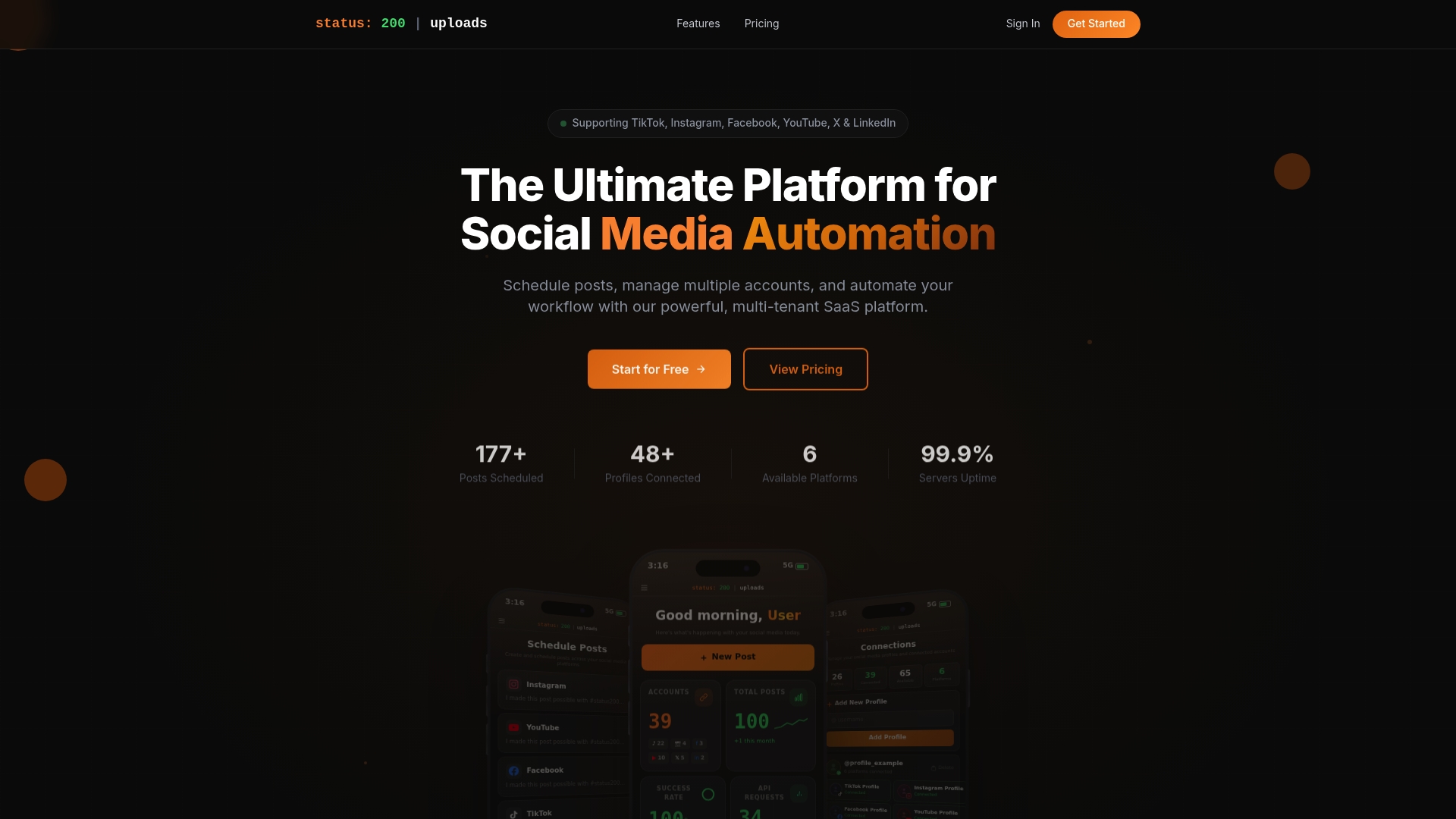
The Status 200 Uploads scheduler is built for SMBs and marketing teams that want the efficiency of automation without losing control over content quality. You can connect TikTok, Instagram, Facebook, YouTube, X, and LinkedIn from one dashboard, schedule posts in advance, and still jump in manually when a moment calls for it. The platform supports rich media, multi-account management, and workflow automation through Zapier and Make.com integrations. If you’re ready to see how it fits your budget and workflow, check out pricing for social scheduler and find the plan that matches your team’s needs.
Frequently asked questions
What is the main difference between manual and automated posting?
Manual posting involves publishing each post by hand in real time, while automated posting uses scheduling tools to publish content at preset times. The core difference comes down to workflow control versus scalability.
Does manual posting get more engagement than automated posting?
Recent experiments show manual posts earn 2-3x more impressions and up to 70% higher engagement compared to automated posts in certain cases, particularly when platform algorithms favor native publishing.
Are there any risks with automated posting?
Yes. Automation poses risks like silent publishing failures, outdated content going live at the wrong time, and reduced personalization, especially when scheduled content isn’t actively monitored.
How do SMBs decide which method to use?
SMBs should weigh campaign goals, available staff time, and target engagement levels. Combining both methods is often the most effective approach, using automation for volume and manual posting for high-impact moments.