Platform-Specific Posting: Boost Engagement with Tailored Strategies
Learn how platform-specific posting increases engagement by 23% over crossposting. Get workflow tips, benchmarks, and best practices for social media managers.

Posting the same content across every platform feels efficient, but it often works against you. Platform-specific posting outperforms simple crossposting because each network has its own audience expectations, content formats, and algorithm signals. Treating TikTok like LinkedIn, or Instagram like Facebook, sends the wrong signals to both the algorithm and your followers. This article breaks down what platform-specific posting actually means, how to build a workflow around it, and what benchmarks to use as your guide. By the end, you will have a clear, actionable strategy you can apply even with a lean team and limited time.
Table of Contents
- What is platform-specific posting?
- How platform-specific posting works: Workflow and time savings
- Platform benchmarks: Frequency, formats, and engagement rates
- Nuances and best practices for small business teams
- Our perspective: What most guides get wrong about platform-specific posting
- Try platform-specific posting made easy with Status 200 Uploads
- Frequently asked questions
Key Takeaways
| Point | Details |
|---|---|
| Tailor for engagement | Customizing content for each platform significantly boosts social media engagement rates. |
| Save time with workflows | Repurposing pillar content and batching adaptations helps small teams scale posting without burnout. |
| Hybrid is best | A mix of tailored posts and selective crossposting maximizes reach while keeping resources manageable. |
| Start small, iterate | Begin with 2–3 platforms, use analytics, and refine strategy instead of aiming for all-platform perfection. |
What is platform-specific posting?
Platform-specific posting means creating or adapting content to match the unique characteristics of each social network you publish on. It is not just about resizing an image. It means adjusting your tone, format, hashtag count, video length, caption style, and even your call to action based on what each platform rewards.
Crossosting, on the other hand, means taking one piece of content and publishing it identically everywhere. Sometimes that is fine. But when you post a 2,200-character LinkedIn essay directly to Twitter X with 15 hashtags and a vertical video meant for Reels, you are sending content that feels out of place to every audience at once.
Platform-specific content tailors each post for the platform’s audience, features, and algorithms. That means your Instagram caption leads with a visual hook, your LinkedIn post leans professional with a value-driven narrative, and your TikTok uses trending audio and fast cuts.
Here is a quick look at how the two approaches compare:
| Feature | Crossposting | Platform-specific |
|---|---|---|
| Content format | Identical across all | Adapted per platform |
| Tone and voice | Uniform | Audience-matched |
| Hashtag use | Same set everywhere | Platform-optimized |
| Video length | One version | Trimmed per platform |
| Algorithm alignment | Low to moderate | High |
| Time investment | Low | Moderate |
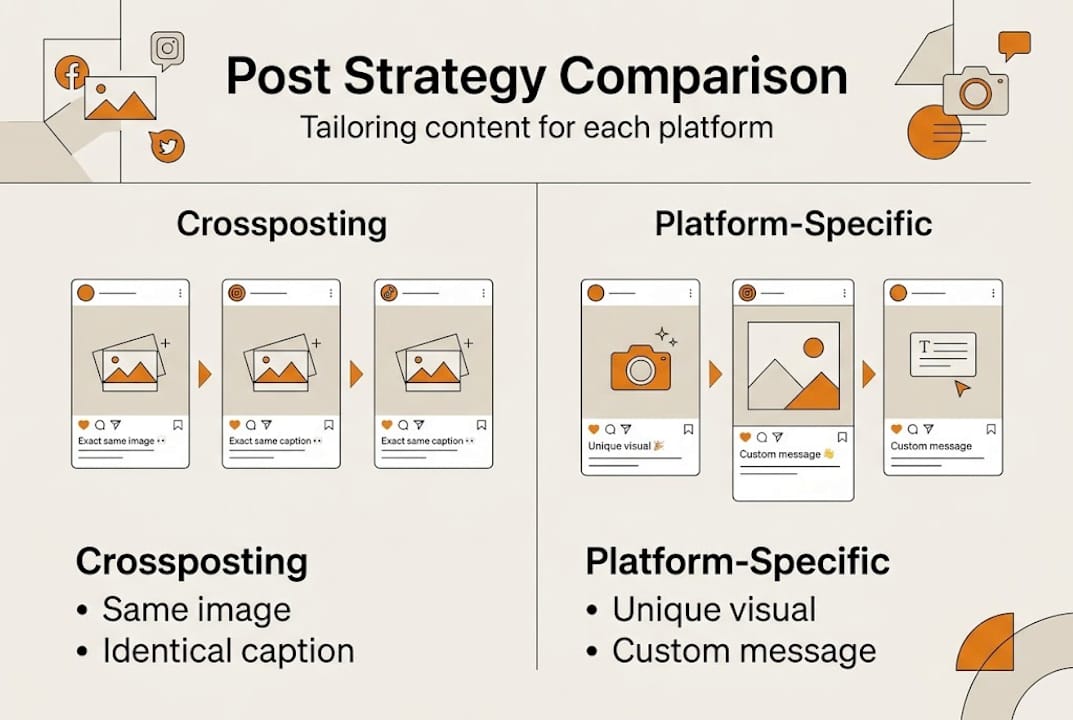
The differences show up most clearly in how platforms reward native behavior. Content adapted per platform performs significantly better because the algorithm interprets it as organic, platform-native activity.
Here are three examples to make this concrete:
- Instagram: Short, punchy captions with 3 to 5 relevant hashtags, a strong visual or Reel, and a clear call to action in the first line. Stories and carousels drive saves and shares.
- LinkedIn: Longer narrative posts (600 to 1,200 words), professional tone, personal insights, and only 2 to 3 hashtags. Polls and document posts tend to generate high comment engagement.
- TikTok: Hook within the first 2 seconds, trending audio or original sound, text overlays, and a conversational tone. Videos between 15 and 60 seconds perform well for most business accounts.
“The platforms that see the highest organic reach are those where creators speak the native language of the community, not just broadcast the same message louder.”
For teams managing social media scheduling across multiple accounts, understanding these distinctions is the foundation of every strong content calendar.
How platform-specific posting works: Workflow and time savings
With the basics established, let’s walk through how an optimized platform-specific workflow actually looks and why it beats manual posting.
The core concept is pillar content. A pillar piece is a substantial content asset, a blog post, a long video, or a research report, that you produce once and then adapt into smaller, platform-ready formats. You are not creating six unique posts from scratch. You are creating one asset and slicing it into smart variations.
Pillar content workflows save time and increase efficiency by reducing redundant creative work while still allowing for meaningful platform adaptation.
Here is a practical four-step workflow:
- Create the pillar: Write a blog post, record a long video, or build a detailed infographic.
- Categorize your platforms: Group them by content type. Visual-first (Instagram, TikTok), professional (LinkedIn), and community-driven (Facebook, X).
- Adapt by platform: Trim the video for Reels, pull a key insight for a LinkedIn post, turn the infographic into a carousel, clip a 30-second TikTok hook.
- Schedule in batches: Use a unified tool to load all adapted versions, set publish times, and track performance from one place.
Here is how the three approaches compare at each step:
| Step | Pure unique content | Platform-specific adaptation | Crossposting |
|---|---|---|---|
| Content creation | Full rebuild per platform | One pillar, multiple edits | One post, copied |
| Time per post | Highest | Moderate | Lowest |
| Engagement payoff | High | High | Low to moderate |
| Algorithm alignment | High | High | Often penalized |
For small and medium-sized businesses (SMBs), the time math is clear. Pure unique posts take the most resources. Crossposting saves time but can cost you reach. Platform-specific adaptation hits the middle, giving you high engagement without burning out your team.

Pro Tip: Batch all your platform adaptations for the week in one two-hour session. Load them into a scheduling tool, set your post times, and free up the rest of the week for community management and strategy. When you compare scheduling tools, look for ones that let you create separate post versions for each platform from a single draft.
Platform benchmarks: Frequency, formats, and engagement rates
So, how much difference can tailoring really make? Let’s look at the numbers.
Posting frequency and engagement rates vary significantly across platforms, and matching the right cadence is just as important as matching the right format.
Here is a breakdown of what works across four major platforms:
- Instagram: Post 3 to 5 times per week. Reels generate up to 3x more reach than static images. Carousels drive the highest saves and shares. Best posting windows are Tuesday through Friday, mid-morning.
- TikTok: Post once per day if possible. Short-form videos (15 to 60 seconds) with a strong opening hook dominate. Accounts that use trending audio consistently see faster follower growth.
- LinkedIn: Post 3 to 5 times per week. Long-form posts and document carousels outperform plain text updates. Tuesday and Wednesday mornings are peak engagement windows.
- Facebook: Post 3 to 5 times per week. Video content, especially native uploads, gets prioritized over link shares. Groups and community posts often outperform brand page posts.
Platform-specific content can increase engagement by 23% compared to identical crossposted content. That is not a marginal difference. For a business running five posts per week, that kind of lift compounds fast.
“Accounts that consistently use native features, like LinkedIn carousels, Instagram Reels, and TikTok duets, see disproportionately high organic reach compared to those who only post static, format-agnostic content.”
The research consistently shows that leveraging native features is one of the fastest ways to boost reach without increasing ad spend. The platforms themselves reward users who adopt their newest tools early.
Nuances and best practices for small business teams
Benchmarks aside, here’s how busy social teams can apply best practices without burning out.
First, know when crossposting is actually fine. Time-sensitive announcements, flash sales, event reminders, or urgent news updates do not always need platform-specific treatment. Speed matters more than optimization in those cases. The risk of pure crossposts triggering algorithm penalties applies mostly to evergreen content where the algorithm has time to evaluate performance signals.
For ongoing content, a hybrid approach is the most sustainable model. An 80/20 split, where 80% of your posts are platform-adapted and 20% are straightforward crossposts for announcements, gives you quality where it counts without overwhelming a small team.
Pro Tip: Do not try to be active on every platform at once. Start with 2 to 3 networks where your audience is most active, build a repeatable workflow there, and expand once the process feels natural. Spreading too thin creates mediocre results everywhere instead of strong results somewhere.
Here are three best practices for SMB social media managers:
- Repurpose before you recreate: Always check whether existing content can be adapted before building something new from scratch.
- Match format to behavior: Spend ten minutes studying how top accounts in your category post on each platform. Observe format, caption length, and hashtag use.
- Let data lead the next move: Run each adapted post for two to four weeks, then use analytics to refine strategy based on what actually worked.
Building a smart platform posting workflow also means knowing your limits. Two strong, well-adapted posts per platform per week will consistently outperform five rushed, identical crossposts.
Our perspective: What most guides get wrong about platform-specific posting
Most advice on platform-specific posting treats perfection as the goal. Spend hours tailoring each post, nail every format, and optimize every caption. That sounds great in theory. In practice, it burns out small teams within weeks.
The real insight is this: consistency beats perfection. A team that publishes good, adapted content every week will outperform a team that publishes perfect content once a month. The algorithm rewards regular engagement signals, not occasional masterpieces.
What most guides also miss is that the hybrid model is not a compromise. It is the smart play. You do not have to choose between crossposting everything or rebuilding every post from scratch. Batch-adapting your pillar content takes less time than people expect, especially once the workflow is repeatable.
We have seen SMBs triple their organic reach not by working harder but by working smarter with a clear system. See efficient scheduling in action and you will notice that the best results come from iteration, not one-off perfection. Build the system, track what works, and improve each month.
Try platform-specific posting made easy with Status 200 Uploads
Ready to streamline your social posts across every platform? Applying a platform-specific strategy does not have to mean more hours in your week.
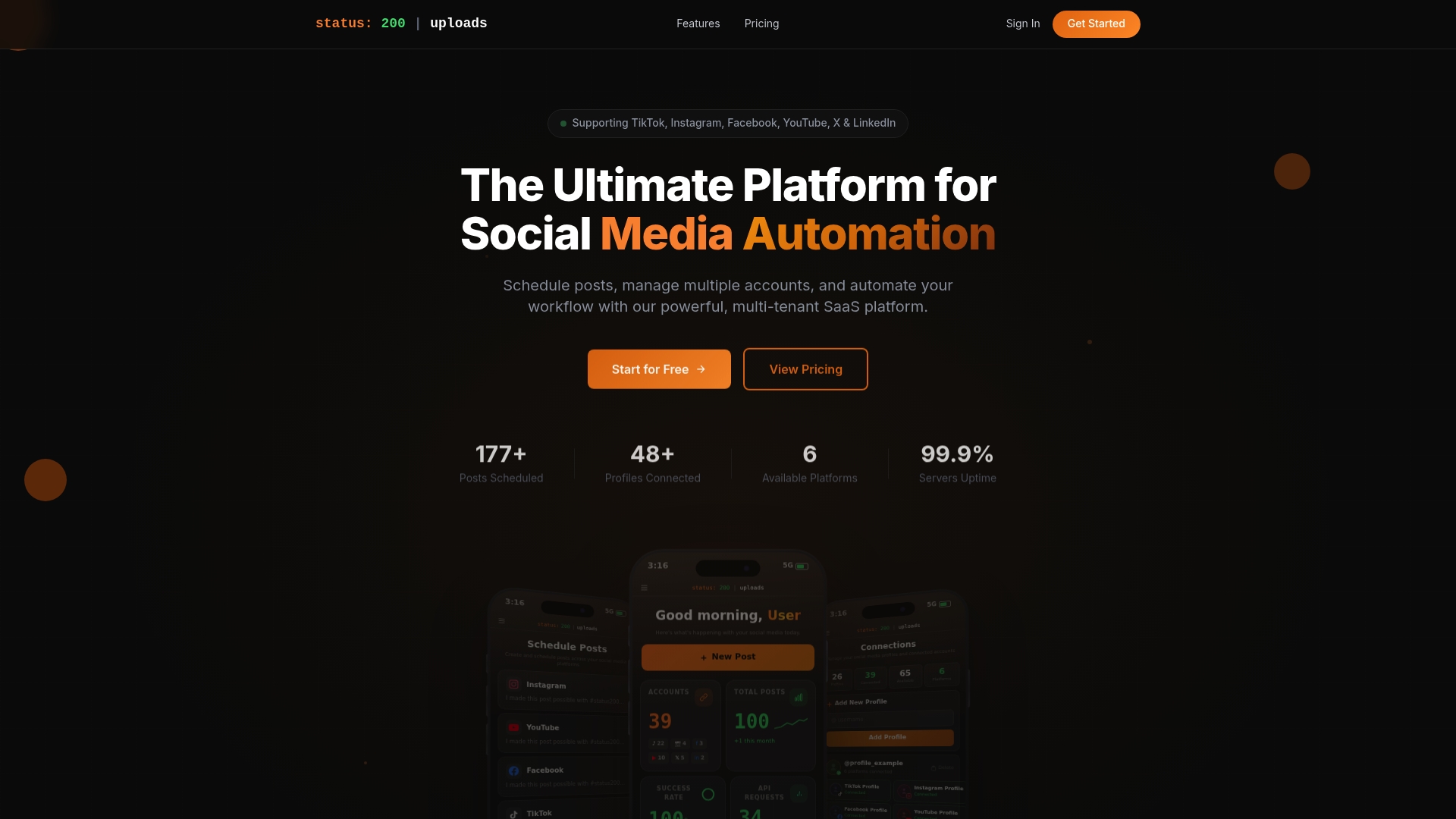
Status 200 Uploads brings platform adaptation, batch scheduling, and post tracking into one dashboard. You can connect your TikTok, Instagram, LinkedIn, Facebook, YouTube, and X accounts, create platform-specific versions of each post, and schedule everything in one session. No more jumping between apps or losing track of what went where. The analytics features let you see exactly which adaptations are landing so you can keep improving. Check out plans and pricing and start building a smarter posting workflow today.
Frequently asked questions
What is platform-specific posting in social media?
Platform-specific posting is customizing your content’s format, tone, and strategy for each social network to maximize engagement and reach.
Does crossposting hurt engagement?
Yes, identical crossposted content can lower engagement and sometimes trigger algorithm penalties, making tailored posts consistently more effective.
How many platforms should small businesses focus on?
Start with 2 to 3 social networks that best fit your audience and scale once your workflow is efficient and repeatable.
What posting frequency works best for engagement?
Benchmarks suggest Instagram and LinkedIn at 3 to 5 times per week, TikTok at once per day, and Facebook at 3 to 5 times per week for the best results.
Can one tool help with platform-specific posting?
Yes, unified scheduling tools like Status 200 Uploads allow you to adapt, schedule, and track content for each platform from a single dashboard efficiently.
Recommended
- Status 200 Uploads — Schedule Posts to TikTok, Instagram, FB, YouTube, X & LinkedIn
- Blog — Status 200 Uploads
- Status 200 Uploads vs Upload-Post — 2026 Comparison
- Status 200 Uploads vs Sprout Social — 2026 Comparison
- Boost digital engagement: proven strategies for creators
- Content creation tips for signage to boost engagement