Optimize your social media posting for max engagement
Learn how to optimize your social media posting strategy across platforms with a step-by-step workflow covering scheduling, AI tools, analytics, and authentic content.

Posting inconsistently across platforms is one of the fastest ways to lose audience momentum. One missed week on Instagram or a poorly timed LinkedIn drop can set back weeks of growth. The good news is that a structured posting workflow, backed by the right tools and current platform knowledge, fixes this problem at the root. This guide walks you through everything from setup to analytics, covering the role of AI, short-form video, and scheduling automation. As short-form video becomes essential for engagement in 2026, having a repeatable system is no longer optional.
Table of Contents
- Prepare your posting strategy: What you need before you start
- Step-by-step workflow: Posting efficiently across channels
- Avoiding common mistakes: Troubleshooting your posting process
- Measuring success: Verifying and optimizing your social strategy
- Why authentic content still wins in the age of automation
- Take your social posting to the next level
- Frequently asked questions
Key Takeaways
| Point | Details |
|---|---|
| Start with the right tools | Getting cross-platform access and an organized content calendar is critical for efficiency. |
| AI accelerates, human refines | Automate your workflow with AI, but always review posts for authentic brand voice. |
| Customize per platform | Tailor every post for the specific platform’s audience and format for best results. |
| Track results routinely | Use analytics to monitor performance and update your strategy for continual growth. |
| Prioritize authenticity | Genuine content wins engagement even as automation and AI tools scale your reach. |
Prepare your posting strategy: What you need before you start
Before you touch a scheduling tool, you need a clear picture of what you’re working with. Jumping straight into posting without preparation is like packing for a trip without knowing your destination. The setup phase is where most teams either gain a serious advantage or create chaos they’ll deal with for months.
Start by listing every social media account your business owns. Include the platform, the login credentials, and who manages each one. This sounds basic, but many small teams discover duplicate accounts, forgotten profiles, or outdated bios during this step. Clean data at the start saves real headaches later.
Next, build a content calendar. You don’t need anything fancy. A shared spreadsheet works fine. Map out your upcoming campaigns, product launches, seasonal moments, and recurring content themes for at least four weeks ahead. This gives you a runway to batch-create content instead of scrambling daily.
Key preparation checklist:
- Confirm login access for all platforms (TikTok, Instagram, Facebook, YouTube, X, LinkedIn)
- Audit existing content: what performed well, what flopped
- Document brand voice guidelines and visual standards
- Identify your peak audience activity windows per platform
- Prepare a library of reusable creative assets (logos, brand colors, evergreen copy)
- Choose a scheduling tool that lets you schedule across platforms from one dashboard
Choosing the right tool matters more than most people realize. A tool that forces you to log into each platform separately defeats the purpose of automation. Look for cross-platform integration, media storage, and post-level analytics as baseline features.
Understanding platform algorithms is equally important. In 2026, short-form video is essential and AI tools are reshaping content creation, but human editing remains critical for preserving brand authenticity. Algorithm preferences shift, and what worked in 2024 may actively hurt your reach today.
| Platform | Preferred format in 2026 | Optimal post frequency |
|---|---|---|
| TikTok | Short-form video (15-60 sec) | 1-3x daily |
| Reels + carousel | 4-7x weekly | |
| Text posts + native video | 3-5x weekly | |
| Video + community posts | 3-5x weekly | |
| YouTube | Long-form + Shorts | 2-3x weekly |
| X | Text + threads | 5-10x daily |
Pro Tip: Batch your creative assets in theme clusters. Group visuals, captions, and hashtags by campaign so your scheduling sessions take minutes, not hours.
Step-by-step workflow: Posting efficiently across channels
With preparations complete, let’s walk through the exact workflow that top-performing teams use for efficient, multi-platform posting.
Step 1: Create platform-specific content variations. Never copy-paste the same caption across every platform. LinkedIn audiences expect professional context. TikTok viewers want energy and brevity. Instagram rewards visual storytelling. Write a core message, then adapt the tone, length, and format for each channel. This takes an extra 10 minutes per post and dramatically improves performance.
Step 2: Use AI tools to accelerate drafting. AI writing tools can generate caption drafts, suggest hashtags, and even recommend posting times based on historical data. The speed gain is real. However, AI aids efficiency but human editing is what keeps your brand voice intact. Always review AI output before it goes live.
Step 3: Organize and upload your media assets. Upload all images and videos to your scheduling platform’s media library before you start scheduling. This prevents last-minute file hunting and keeps your workflow clean.
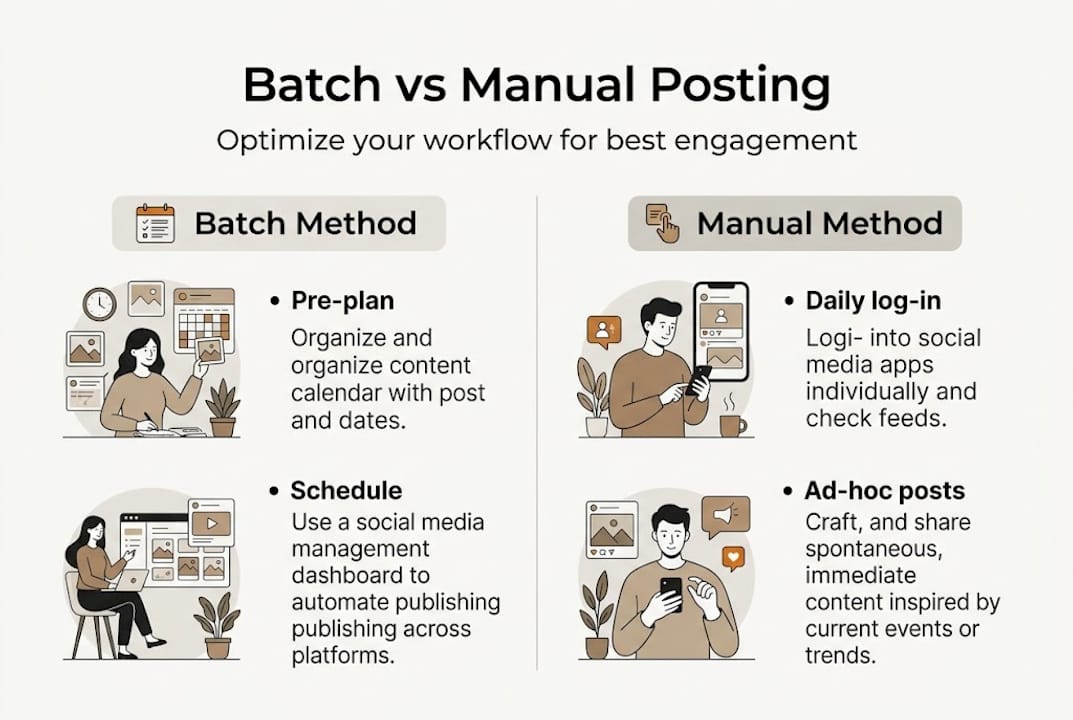
Step 4: Batch schedule your posts. Set aside one or two sessions per week to schedule everything in advance. Load your content into your tool, assign platforms, set times, and review previews. Status 200 scheduling features let you manage multiple accounts from a single dashboard, which cuts the time spent switching between apps.
Step 5: Monitor live performance. After posts go live, check engagement within the first two hours. Early signals tell you whether a post is gaining traction or needs a boost through engagement (replying to comments, sharing to Stories).
| Approach | Time per week | Consistency | Engagement quality |
|---|---|---|---|
| Manual posting | 8-12 hours | Low to moderate | Variable |
| Batch scheduling | 2-4 hours | High | Consistently strong |
| Full automation (no review) | Under 1 hour | High | Often lower |
The table makes it clear: batch scheduling with human oversight is the sweet spot. Full automation without review risks off-brand posts and missed context. Check social scheduling pricing if you’re evaluating tools that support this workflow.
Pro Tip: Schedule your highest-effort content for Tuesday through Thursday mornings. Across most platforms, mid-week morning slots consistently outperform weekend posts for B2B and SMB audiences.
Avoiding common mistakes: Troubleshooting your posting process
Even with a solid workflow, mistakes can undermine your efforts. Here’s how to spot and fix common issues.
The most widespread mistake is posting the same content across every platform without customization. A 60-second TikTok video repurposed as a Facebook post without any edits will underperform on both. Each platform has its own native content behavior, and ignoring that means leaving engagement on the table.
Common mistakes and how to fix them:
- Ignoring engagement windows: Post when your audience is actually online. Use platform analytics to identify peak times, then schedule around them. Posting at 2 a.m. because your queue ran out is not a strategy.
- Skipping quality checks on automated posts: Automation is powerful, but a scheduled post that goes out with a broken link or an outdated promotion can damage trust. Build a review checkpoint into your workflow.
- Using repetitive content formats: Algorithms penalize accounts that post the same format repeatedly without variation. Mix video, image carousels, polls, and text posts to signal content diversity.
- Missing trend windows: Short-form video drives engagement in 2026, and trending audio or formats have short shelf lives. If your content calendar is too rigid, you’ll miss these windows entirely.
- Neglecting posting compliance: Each platform has specific rules around link placement, image dimensions, and promotional language. Violating these can suppress your reach or get posts removed.
“The brands that grow fastest on social media aren’t the ones posting the most. They’re the ones posting with the most intention.”
One overlooked issue is over-scheduling. Flooding your feed with low-effort posts to hit a frequency target backfires. Algorithms on Instagram and LinkedIn actively reduce the reach of accounts with high post volume but low engagement rates. Quality over quantity is not just a cliche here. It’s measurable.
Another trap is ignoring comments and DMs after posting. Engagement is a two-way signal. Platforms reward accounts that respond quickly because it indicates active community management. Even a brief reply within the first hour can meaningfully boost a post’s algorithmic reach.
Measuring success: Verifying and optimizing your social strategy
Troubleshooting solved, let’s focus on how you can measure and maximize the results of your posting efforts.
You can’t optimize what you don’t measure. But tracking every possible metric leads to analysis paralysis. Focus on the metrics that connect directly to your business goals.
Core metrics to track:
- Engagement rate: Likes, comments, shares, and saves divided by reach. This tells you how resonant your content is.
- Reach and impressions: How many unique accounts saw your post versus total views. A high impression-to-reach ratio means people are viewing your content more than once.
- Click-through rate (CTR): For posts with links, CTR shows whether your content is compelling enough to drive action.
- Follower growth rate: Steady growth signals healthy content strategy. Sudden drops often correlate with a specific post or change in posting behavior.
- Conversion rate: The ultimate metric for business-focused accounts. Track how many social visitors complete a desired action (purchase, sign-up, inquiry).
Scheduling platforms with built-in analytics features make this process far less manual. Instead of exporting data from five different platforms, you get a consolidated view of what’s working.
Statistic callout: AI enables smarter analytics and performance tracking, but human insight is what turns data into decisions. Numbers tell you what happened. Your team’s judgment tells you why and what to do next.
Run a monthly strategy review. Pull your top five and bottom five posts from the past 30 days. Look for patterns in format, timing, topic, and tone. Apply those insights to the next month’s calendar. This compounding feedback loop is what separates accounts that plateau from those that grow consistently.
Why authentic content still wins in the age of automation
Having discussed how to optimize and analyze your posting, let’s consider a perspective that many guides overlook.
Every guide covers automation. Fewer talk honestly about its ceiling. AI tools are genuinely useful for scaling output and reducing repetitive work. But there is a hard limit to what automation can do for your brand.
Emotional resonance cannot be templated. The posts that generate real conversation, the ones people screenshot and share with a friend, almost always have a human fingerprint. A specific story. An unexpected opinion. A moment of honesty that no AI prompt reliably produces.
Brands that treat human editing of AI content as a non-negotiable step consistently outperform those that publish raw AI output. The difference shows up in comment quality, share rates, and long-term follower loyalty. Authenticity is not a soft metric. It’s a performance multiplier.
The smartest approach is to use automation for the mechanical work: scheduling, formatting, resizing, distributing. Use human creativity for the work that actually builds a brand: the angle, the voice, the story. When you apply authentic posting principles on top of an efficient workflow, the results compound faster than either approach alone.
Efficiency without authenticity gets you reach. Authenticity without efficiency limits your scale. You need both.
Take your social posting to the next level
Ready to put these strategies into practice? The workflow in this guide works best when your tools match your ambition.
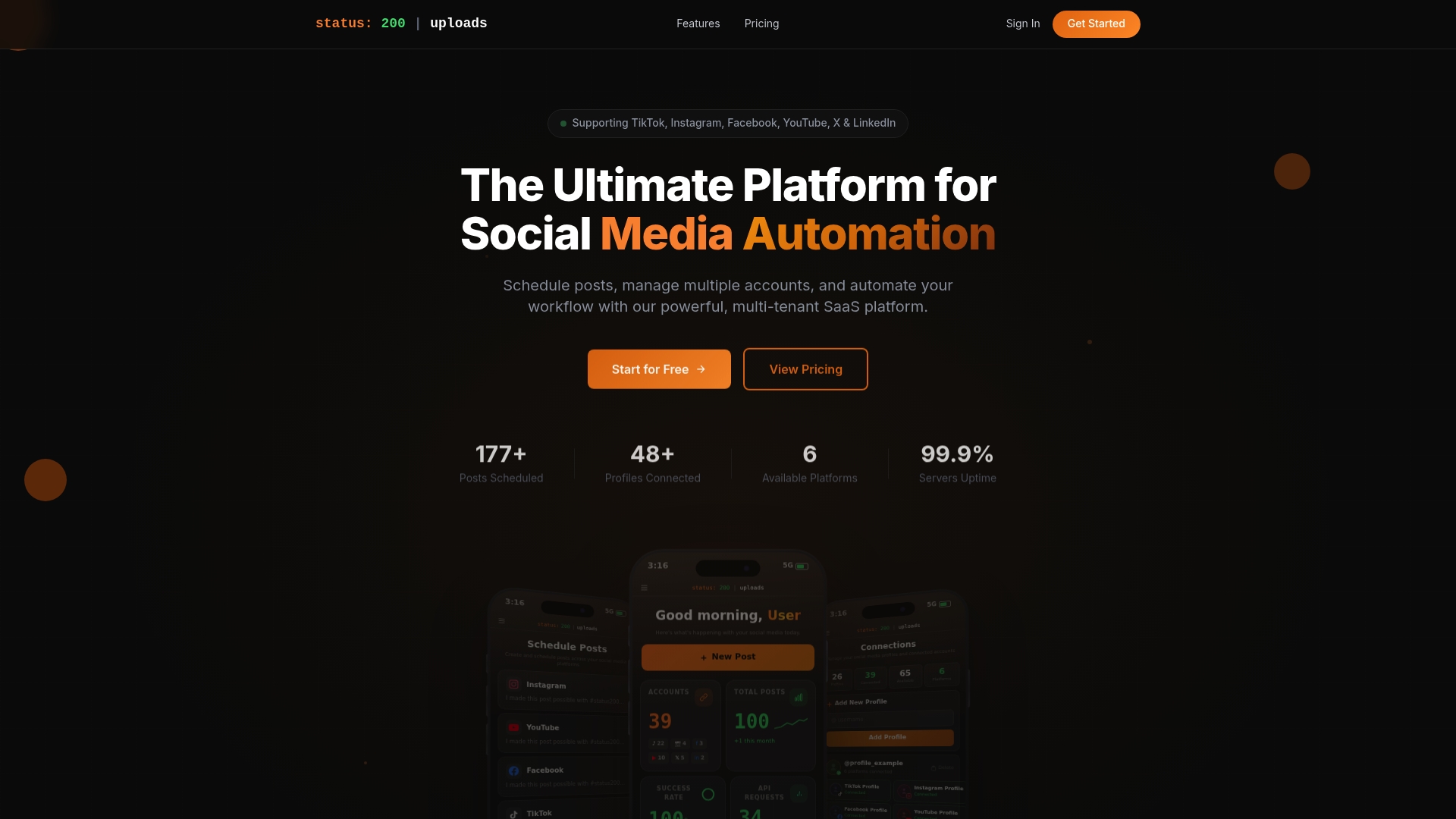
Status 200 Uploads is built for exactly this kind of multi-platform posting operation. You can schedule your posts across TikTok, Instagram, Facebook, YouTube, X, and LinkedIn from one dashboard, with full control over platform-specific settings, media organization, and post tracking. No more tab-switching or manual uploads per platform. For teams evaluating options, the free scheduler pricing page breaks down what’s available at every tier, including options built for small businesses and agencies. Smarter posting starts with the right infrastructure.
Frequently asked questions
What is the most efficient way to schedule social media posts across multiple platforms?
Use a scheduling tool with built-in cross-platform integration so you can automate posts and monitor results in one dashboard. AI aids efficiency but always pair automation with human review for best results.
How do AI tools help optimize social media posting?
AI tools streamline content drafting and scheduling, but human edits are necessary to maintain authenticity. Short-form video and AI tools work best together when a real person reviews the final output before it goes live.
What are the most important metrics to track for social posting success?
Focus on engagement rate, reach, CTR, and conversion metrics, and review data monthly to refine your strategy. AI-driven analytics surface the numbers, but human insight drives the decisions that improve them.
Why is short-form video important for social media in 2026?
Short-form video boosts algorithmic preference and drives higher engagement rates across most major platforms. Short-form video is essential for any business serious about organic growth in 2026.