Centralize social media management to save time and boost results
Discover why centralize social media management can streamline your workflows, save time, and enhance your brand's impact across platforms.

Managing five different platforms through five different workflows feels organized until it isn’t. Most small and medium-sized business teams quietly lose hours each week logging into separate accounts, rebuilding approval chains from scratch, and wondering why their brand messaging drifts from platform to platform. Centralizing your social media management fixes all of that, but only when you do it correctly. This article breaks down what centralization actually means, the real advantages it brings lean teams, the risks to watch out for, and how to build a model that scales with your business instead of against it.
Table of Contents
- Understanding centralized social media management
- Key benefits of centralizing social media management
- Potential drawbacks and getting the balance right
- How to centralize your social media management effectively
- A modern perspective: Why hybrid centralization works best
- Simplify and scale: Unlock the benefits of centralization with Status 200 Uploads
- Frequently asked questions
Key Takeaways
| Point | Details |
|---|---|
| Centralization boosts efficiency | Managing all channels in one place saves time and minimizes duplicated effort for small teams. |
| Flexible models work best | Combining central controls with localized content ensures both consistency and agility. |
| Beware of rigid processes | Too much centralization can dampen creativity or slow down responses during critical moments. |
| Start with a workflow audit | Assess your current approach before choosing tools and policies to centralize management. |
Understanding centralized social media management
Centralization in social media management means pulling your strategy, governance, approvals, and reporting into one coordinated system instead of running each channel as its own isolated project. It does not mean that one person controls every post or that all creativity flows from a single source. That is a common misconception that stops many SMB teams from even trying.
In practice, centralization typically covers three core layers. Strategy is decided centrally: the brand voice, campaign goals, posting cadence, and target audience. Governance is also managed centrally: who approves what, what content policies apply, and which brand assets are acceptable. Reporting runs from a unified view so you can compare performance across platforms without exporting six different CSV files. Following content publishing best practices from a single point of control makes these decisions consistent and easier to enforce.
A centralized control layer paired with localized execution is the expert-recommended model for small-to-mid businesses. This means your marketing manager sets the campaign direction while a local team member or a community manager adapts the tone for a specific audience or platform. You get consistency without sacrificing relevance.
Here is a quick breakdown of what typically belongs at each level:
| Task or function | Centralized or local? | Reason |
|---|---|---|
| Brand voice and tone guidelines | Centralized | Consistency across every audience touchpoint |
| Campaign goals and KPIs | Centralized | Strategic alignment and measurable outcomes |
| Content approval | Centralized | Governance and quality control |
| Cross-platform reporting | Centralized | Unified performance view |
| Platform-specific captions | Local or hybrid | Adapts to format and audience norms |
| Real-time community responses | Local | Speed and contextual relevance |
| Influencer or local event content | Local or hybrid | Requires on-the-ground knowledge |
Understanding this split is where most guides stop. But knowing why certain tasks stay local is just as important as knowing what to centralize. Local execution keeps your content feeling native to each platform while the centralized layer prevents your brand from fragmenting.
Key benefits of centralizing social media management
Now that you know what centralizing involves, here is why it matters most, especially for lean teams focused on growth and efficiency.
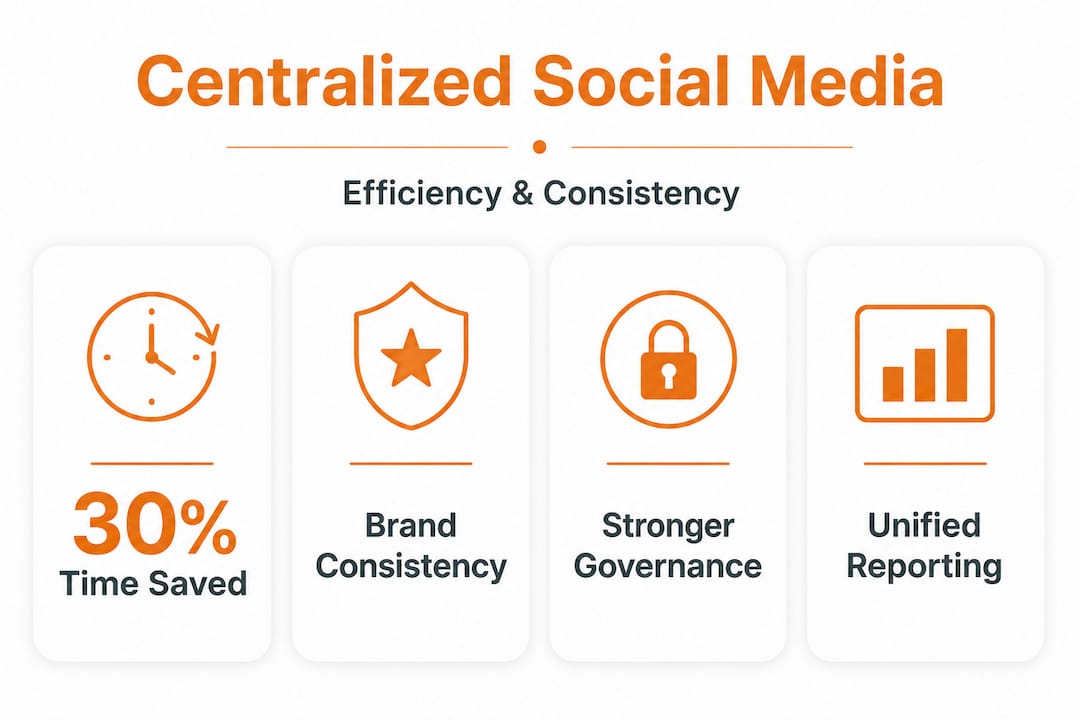
The most immediate benefit is time savings. When your scheduling, approvals, and reporting live in one place, you eliminate the constant context-switching that drains productivity. A social media manager who normally logs into TikTok, Instagram, Facebook, YouTube, X, and LinkedIn separately can instead handle everything through a single dashboard. That alone can reclaim several hours each week. Guidance on streamlining social posting shows how unified workflows directly reduce the manual overhead that bogs down small teams.

Beyond time, centralization creates brand consistency that is genuinely hard to achieve any other way. When every team member pulls from the same approved asset library, follows the same content calendar, and routes posts through the same approval workflow, your messaging stays coherent. Customers who follow you on Instagram and LinkedIn see the same brand, even if the format and caption style differ.
A centralized approach also allows for more effective governance, approval, and reporting, which matters for SMBs because there are usually very few people responsible for a large amount of content output. Without a centralized governance structure, one overlooked post can go out with the wrong tone, the wrong image, or even inaccurate product information. The cost of that mistake, whether reputational or financial, often exceeds the setup effort for a proper centralized system.
Content repurposing also becomes far more practical. When you can see all your content from one dashboard, it is easier to spot what performed well on one platform and adapt it for another. A LinkedIn article summary that drove high engagement can become a short video script for TikTok. A Facebook carousel can become an Instagram Reel concept. This kind of cross-platform thinking is only efficient when your content library and performance data are in one place.
Key benefits at a glance:
- Single dashboard: Eliminate multi-login fatigue and reduce admin time significantly
- Unified brand voice: Every post reflects the same guidelines, regardless of who created it
- Simplified analytics: Compare platform performance without manual data consolidation
- Faster repurposing: Identify high-performing content and adapt it across channels quickly
- Improved accountability: Clear ownership for approvals, publishing, and tracking
For guidance on timing, scheduling social media posts strategically is one of the most impactful decisions a centralized workflow enables, because you can plan for peak engagement windows across all platforms at once.
Pro Tip: Before you centralize, map your current approval process end-to-end. Most teams discover two or three redundant steps that slow everything down. Removing those before migrating to a central system prevents you from simply automating a broken workflow.
Potential drawbacks and getting the balance right
While the benefits are compelling, no single model fits all. Here is what to consider before going all-in on centralization.
The biggest risk is rigidity. When every post, every caption edit, and every reactive comment has to pass through a central approval queue, your team loses the ability to respond quickly to trending moments or local events. Social media moves fast, and a five-step approval chain can make your brand feel tone-deaf during moments that require agility.
There is also the risk of losing local flavor. If a national brand forces every regional location to use identical content, the audience in each location may feel disconnected. The hybrid model approach resolves this by setting clearer responsibility boundaries. Central teams set the direction; local teams adapt and execute. This structure avoids the main failure mode of rigid centralization.
“Centralized workflows can slow real-time responsiveness or reduce local creativity if approvals become too rigid; hybrid models and clearer responsibility boundaries help avoid this.”
The comparison below shows how full centralization stacks up against a hybrid model across practical scenarios:
| Scenario | Full centralization | Hybrid model |
|---|---|---|
| Trending topic response | Slow, requires central approval | Fast, local teams can act within guardrails |
| Brand consistency | Very high, uniform output | High, with guidelines applied locally |
| Creative diversity | Limited, single voice | Higher, local adaptation allowed |
| Reporting clarity | Excellent | Excellent with shared tools |
| Team autonomy | Low, can reduce engagement | Balanced, motivating for local contributors |
| Setup complexity | Lower | Moderate, requires policy clarity |
The hybrid model wins in most real-world SMB scenarios because it pairs strategic control with operational speed. Decisions about manual vs automated posting also factor in here. Automation handles the scheduled, planned content. Manual posting stays available for real-time moments. A good centralized system accommodates both rather than forcing you to pick one.
Pro Tip: Create a tiered response policy. Tier one content, such as planned campaigns and brand promotions, always goes through central approval. Tier two content, such as reactive posts to trending topics or local events, can be approved by a direct manager in under 30 minutes. This prevents your centralized system from becoming a bottleneck.
How to centralize your social media management effectively
You know the pros and cons. Now let’s break down how to implement centralization smoothly, even with limited time or resources.
Aiming for a centralized control layer reduces confusion and increases strategic alignment across your whole team. The following steps will get you there without overwhelming your current workflow.
-
Conduct a full workflow audit. Document every platform you are currently active on, who manages each one, how content gets created, and how posts are approved. You will likely find duplicated work, missing approval steps, and inconsistent guidelines. This audit is your before picture and it will make the case for change internally.
-
Select a central platform. Choose a tool that supports all the platforms your brand uses. The platform should allow you to schedule posts, manage multiple accounts, track performance, and run approval workflows without requiring you to leave the dashboard. Verify that it integrates with tools your team already uses.
-
Document your brand policies. Write a clear social media policy that covers brand voice, image standards, restricted topics, response protocols, and the approval chain. This document becomes the foundation of your centralized governance layer. Without it, centralization is just a new login screen.
-
Train your team on the new system. Hold at least one structured training session before launch. Cover how to draft and schedule posts, how to submit content for approval, and how to interpret performance reports. Include any local team members who will be executing content under the central framework.
-
Define your metrics and reporting cadence. Decide which key performance indicators matter: reach, engagement rate, click-through rate, follower growth, or conversion. Set a weekly or monthly review date so performance data actually informs your strategy rather than sitting unread in a dashboard.
-
Automate what can be automated. Recurring posts, evergreen content series, and scheduled campaigns are ideal candidates for automation. Guidance on automating posting times can dramatically reduce the manual labor involved in maintaining a consistent posting schedule.
-
Review and refine regularly. Centralization is not a one-time project. Schedule a quarterly review of your workflows, approval processes, and tool stack. As your team grows or your platform mix changes, your system should evolve with it. Tips on multi-platform engagement can guide how to adjust your scheduling strategy as you scale.
Ongoing improvement checklist:
- Review approval bottlenecks every quarter
- Audit your content library for outdated or off-brand assets
- Reassess platform selection based on where your audience is growing
- Check automation rules for accuracy and relevance
- Gather feedback from local team members on what is working and what is slowing them down
A modern perspective: Why hybrid centralization works best
Most articles on this topic treat centralization as a binary choice: either you centralize everything or you do not. That framing misleads a lot of SMB teams into either over-centralizing and creating a slow, approval-heavy bureaucracy, or under-centralizing and ending up with fragmented, inconsistent channels. Neither extreme serves you well.
From where we sit, working with social media managers and marketing teams across many industries, rigid centralization almost never works perfectly for SMBs. The teams that succeed are the ones who treat centralization as a flexible framework rather than a fixed rule. They centralize the things that genuinely need control, which is strategy, brand standards, reporting, and governance, and they leave room for local speed and creativity where those qualities matter most.
The concept of hybrid models and clearer responsibility boundaries is not just a theoretical nuance. It is a practical answer to a real operational problem. When local team members feel like they have zero autonomy, engagement often drops, both the team’s internal engagement and often the content’s performance with audiences. When central teams feel like their guidelines are being ignored, brand quality erodes. The hybrid approach resolves this tension by making boundaries explicit rather than leaving them to interpretation.
What most guides also miss is the role of choosing the right media formats within a centralized strategy. Format decisions, video versus static image, short form versus long form, are often left entirely to local creators. But when these choices are guided by centrally set performance data and brand priorities, the results consistently improve. You empower local creators with direction, not just rules.
The strongest centralized systems we see are the ones that give people enough structure to move fast without second-guessing every decision, and enough flexibility to respond to the moment without breaking the brand. That is the gray middle ground most guides skip over, and it is where the real efficiency gains live.
Simplify and scale: Unlock the benefits of centralization with Status 200 Uploads
Putting these principles into practice is significantly easier when your tool is built for exactly this kind of centralized, multi-platform workflow.

Status 200 Uploads is designed for social media managers and marketing teams who want to manage TikTok, Instagram, Facebook, YouTube, X, and LinkedIn from a single dashboard. You can schedule posts, organize your media library, manage multiple accounts, and track performance without jumping between platforms or tools. Workflow automation through Zapier or Make.com integrations means your approval and publishing processes can run on autopilot for planned content, while you stay ready to act manually when a moment calls for it. If you are ready to stop managing social media reactively and start running it strategically, Status 200 Uploads gives you the infrastructure to do it efficiently.
Frequently asked questions
What does it mean to centralize social media management?
It means managing all your social channels from one platform with unified strategy, governance, and reporting. A centralized control layer reduces confusion and increases strategic alignment across your entire team.
What are the disadvantages of centralizing social media management?
The main risk is that rigid processes can slow response times and limit local creativity. Centralized workflows work best when approval chains are streamlined rather than layered, so speed is not sacrificed for control.
How can a hybrid model help with social media management?
A hybrid model keeps strategy and governance centralized while allowing local teams to adapt content and respond quickly. Hybrid models with clear responsibility boundaries balance consistency with the agility that real-time social media requires.
What’s the first step to centralizing social media management?
Start by auditing your current workflows across every active platform to identify gaps, redundancies, and inconsistencies. A clear picture of where things stand makes it easier to build a centralized control layer that actually fits your team’s needs.