Master media management: Proven strategies for streamlined success
Discover essential media management best practices to streamline your content workflows, boost team efficiency, and achieve marketing success.

Managing content across six or more platforms while juggling deadlines, approvals, and performance reviews is one of the most demanding challenges small to medium-sized marketing teams face today. Without a structured system, teams waste hours on repetitive tasks, miss optimal posting windows, and lose track of which assets have already been published. This article walks you through proven frameworks for building efficient media workflows, organizing your content library, distributing posts at scale, and measuring results that actually matter to your business.
Table of Contents
- Establishing a structured media workflow
- Building your content vault and calendar
- Streamlining distribution across multiple platforms
- Platform-specific adaptation and timing
- Choosing and reporting meaningful KPIs
- A smarter media management mindset for 2026
- Power-up your workflow with Status 200 Uploads
- Frequently asked questions
Key Takeaways
| Point | Details |
|---|---|
| Structured workflow wins | A repeatable weekly workflow ensures consistent and measurable results in media management. |
| Centralized assets boost speed | Using content vaults and editorial calendars reduces bottlenecks and allows quick adaptation for multiple platforms. |
| Platform adaptation is crucial | Always tailor content format and timing per platform and avoid verbatim cross-posting to maximize engagement. |
| Metric selection matters | Only report metrics directly tied to business goals and avoid benchmarking across platforms without context. |
| All-in-one tools streamline | Integrated planning, scheduling, and distribution tools cut operational complexity for SMBs. |
Establishing a structured media workflow
A solid media workflow is not a luxury. For smaller teams, it is the difference between a content operation that runs on instinct and one that runs on results. When everyone knows their role, when assets are approved, and when posts go live, you eliminate the constant back-and-forth that drains time and morale.
The most effective approach for small to mid-sized teams follows a repeatable weekly loop. According to research, the practical cycle is Plan → Create → Schedule → Publish → Review → Adjust, ideally using batching and a weekly cadence to maximize efficiency. Batching means grouping similar tasks together. You write all captions in one sitting, edit all videos in another block, and schedule everything before the week begins. This reduces context-switching, which is one of the biggest hidden time costs in content operations.
Here is what each stage looks like in practice:
- Plan: Define topics, assign owners, set deadlines, and lock in channel targets for the upcoming week or month.
- Create: Produce all written copy, visuals, and video assets in dedicated creation blocks rather than one piece at a time.
- Schedule: Load finalized posts into your scheduling platform, adapting format and copy for each platform before queuing.
- Publish: Let your scheduling tool handle publication automatically. Human intervention at this stage should be minimal.
- Review: Audit performance data at the end of each week. What drove clicks? What fell flat?
- Adjust: Carry insights from the review into the next planning session, closing the feedback loop.
Defining clear roles and approval steps is equally critical. If everyone can approve a post, no one truly owns quality control. Assign a content creator, a reviewer, and a final approver. Keep the chain short to avoid bottlenecks, but never skip the review step entirely.
Pro Tip: Use a shared editorial calendar to centralize planning and deadlines. When every team member can see what is scheduled, what is pending approval, and what has already published, you cut down on duplicate work and missed slots. Pair this with scheduling for maximum reach strategies to make sure your posts hit audiences when engagement is highest.
Strong workflows also support optimizing engagement over time because they create a consistent output rhythm that algorithms reward.
Building your content vault and calendar
With a workflow in place, assets and schedules become your backbone for reliable execution. A content vault is essentially a centralized library where every approved asset, caption variant, branded graphic, and video lives. Without one, teams dig through email threads and shared drives, wasting time that should go toward creating.
Best-practice tooling confirms that building reusable asset pipelines, specifically a content vault combined with a calendar and scheduling system, reduces operational churn significantly. When assets are stored centrally, they can be repurposed, adapted for new platforms, and versioned without anyone starting from scratch.
An editorial calendar should act as the hub for all content planning and distribution, not just a list of posting dates. Effective social media management uses shared calendars alongside clear roles, approval workflows, centralized asset libraries, and reporting tied to business outcomes. Together, these elements form a governance system that scales as your team and platform count grow.

Here is a sample structure for a functional content calendar:
| Topic | Channel | Assigned to | Deadline | Status |
|---|---|---|---|---|
| Product launch teaser | Instagram, TikTok | Creative Lead | Monday 9am | In review |
| Customer case study | LinkedIn, Facebook | Content Writer | Tuesday 12pm | Scheduled |
| Behind-the-scenes video | TikTok, YouTube | Video Editor | Wednesday 3pm | Draft |
| Weekly tips carousel | Designer | Thursday 10am | Approved | |
| Industry news roundup | X, LinkedIn | Social Manager | Friday 8am | Pending |
This kind of structure makes it immediately obvious where bottlenecks are forming and who is responsible for each piece of content.
Pro Tip: Tag every asset in your library with platform, format, campaign, and date. When you need to adapt a Facebook graphic for Instagram Stories, you can find it in seconds rather than searching through hundreds of unnamed files. This tagging system also enables you to audit publishing best practices quickly and spot content gaps across channels.
Understanding the difference between manual vs automated workflows is also worth your time here. Manual posting might feel like more control, but it introduces inconsistency and human error that automated systems eliminate entirely.
Streamlining distribution across multiple platforms
Once your assets are organized, the next step is distributing them across channels efficiently and strategically. Distribution is not the same as publishing. Publishing is the act of putting content live. Distribution is the strategic decision about which content goes to which channel, in what format, and at what cadence.
Effective multi-platform distribution works best when you map content to owned, earned, and paid channels and maintain a structured content library with tagging and reuse governance. Owned channels are the platforms you control directly, like your Facebook page or LinkedIn company profile. Earned channels include shares, mentions, and organic reach. Paid channels are your boosted posts and ads.
Mapping content to these three categories helps you prioritize. A detailed case study might perform better as an organic LinkedIn post than a boosted Instagram story. A short, high-energy product clip might be perfect for TikTok and Facebook paid promotion. Understanding this distinction saves budget and improves reach.
Consider this comparison of manual versus automated distribution:
| Factor | Manual distribution | Automated distribution |
|---|---|---|
| Time per post | 15 to 30 minutes | Under 5 minutes |
| Error rate | High (missed platforms, wrong formats) | Low (templates and rules enforce consistency) |
| Scalability | Limited by team bandwidth | Scales with content volume |
| Consistency | Variable | High |
| Platform adaptation | Requires manual editing each time | Rules-based, with platform-specific fields |
| Reporting | Fragmented | Centralized |
For practical guidance on building this kind of system, a media content strategy guide provides strong context on how production and planning decisions affect downstream distribution outcomes.
Pro Tip: Avoid manual cross-posting at all costs. Even copying and pasting the same caption across platforms wastes time and increases the chance of publishing errors. Automate your streamlined multi-platform posting process so your scheduling tool handles the heavy lifting. You focus on strategy; the platform handles execution.
The goal is a distribution system where your team makes decisions once, at the planning stage, and the automation layer carries those decisions through to publication without requiring repeated manual steps. That is how maximizing engagement across platforms becomes achievable without burning out your team.
Platform-specific adaptation and timing
After mapping your channels, the real edge comes from adapting content and posting times to each platform’s unique norms. This is where a lot of teams leave performance on the table. They create one version of a post, push it everywhere, and then wonder why results are inconsistent.
Research on multi-account management is clear on this: avoid duplicate verbatim cross-posting. Adapt content by platform format and timing while keeping the core message consistent. The same product announcement should look and sound different on LinkedIn versus TikTok versus Instagram. On LinkedIn, lean into professional framing and data points. On TikTok, lead with energy and movement. On Instagram, prioritize visual quality and brevity.
2026 engagement benchmarks show dramatic differences across platforms:
- TikTok: approximately 4.25% average engagement rate
- Instagram: approximately 0.48% average engagement rate
- Facebook: approximately 0.15% average engagement rate
These numbers are not a judgment on which platform is “better.” They reflect fundamentally different audience behaviors and algorithmic priorities. Comparing your TikTok engagement to your Facebook engagement is misleading without accounting for follower tier, niche, and content type.
“Empirical benchmarking is most useful when you benchmark the same metric family within the same platform context, not across different platforms or audience sizes.”
Timing matters as much as format. A post published at 7am on a Tuesday for a B2B audience on LinkedIn will likely outperform the same post at 2pm on a Saturday. For TikTok, evening windows on weekdays often show higher activity. Invest time in reviewing your own platform analytics to find the windows specific to your audience, not just general industry averages. For deeper guidance on video campaign benchmarking, the nuances of format and timing become even more important.
Explore platform-specific posting strategies and strategies for engagement growth to build a tailored posting approach for each channel you manage.
Choosing and reporting meaningful KPIs
With content tailored and distributed, measuring what matters ensures continuous improvement and true business impact. The biggest mistake teams make here is reporting on metrics that feel impressive but do not connect to revenue, leads, or customer behavior.
A strong content strategy includes defined content goals, a content audit, and a calendar that acts as a hub, and critically, reports only those metrics that align with chosen goals. If your goal is lead generation, report on link clicks, form submissions, and conversion rates. If your goal is brand awareness, track reach and impressions. If your goal is community building, watch comment volume and shares.
Follow these steps to select KPIs that actually reflect progress:
- Define your goal clearly. “Grow social media” is not a goal. “Generate 50 qualified leads from LinkedIn per month” is a goal.
- Audit your existing content. Identify which posts historically drove outcomes tied to that goal.
- Map specific metrics to the goal. For lead generation, that means tracking click-through rate, landing page visits, and form completions, not follower count.
- Set a review cadence. Weekly for tactical adjustments, monthly for strategic shifts.
- Report only what influences decisions. If a metric does not change how you act, remove it from your report.
Research on social-media metrics highlights a real challenge: many small businesses struggle with KPI selection and metric understanding. The result is wasted reporting effort and misaligned priorities. Choose carefully and stay connected to objectives.
“Companies face challenges identifying social-media KPIs that meaningfully connect platform activity to business outcomes, often defaulting to vanity metrics that offer no operational signal.”
Pro Tip: Follower count is the most common vanity metric. It looks good in a slide deck, but a small, highly engaged audience almost always outperforms a large, passive one. Focus on optimizing reach strategies that drive actual behavior, and use automated posting efficiency tools to free up time for deeper analysis. For broader context on connecting content effort to media ROI strategies, the same principle applies: measurement must serve decisions, not ego.
A smarter media management mindset for 2026
Here is something most guides will not tell you: the biggest risk for SMB marketing teams is not under-investing in tools. It is over-complicating their processes to match what enterprise brands do.
Large companies build elaborate content operations because they have the headcount, budget, and infrastructure to sustain them. When a small team tries to replicate a 50-person agency workflow with three people, the system collapses under its own weight. The result is missed deadlines, inconsistent quality, and burnout.
The model that actually works for smaller teams is what we call the “planning-publishing-learning” membrane. One person or function owns planning. One owns publishing. One owns learning, meaning they pull insights from performance data and feed them back into planning. These do not need to be three different people. They can be three roles that one or two people cycle through in a structured weekly rhythm.
The philosophy behind this model is that clarity beats complexity every time. A simple framework executed consistently produces better results than a sophisticated system used inconsistently. Resist the urge to add more approval layers, more content formats, and more platforms just because they are available. Every addition should earn its place by contributing measurable value.
Keep your core message unified across platforms even as your content adapts to each one. Your brand voice, your core value proposition, and your audience promise should be recognizable whether someone finds you on TikTok or LinkedIn. The format changes. The substance does not.
Revisiting your publishing best practices regularly through this lens ensures that operational decisions remain rooted in what actually serves your audience, not just what feels productive in the moment.
Power-up your workflow with Status 200 Uploads
Putting these strategies into practice requires the right infrastructure. When you are managing multiple platforms, multiple formats, and multiple team members, a single disconnected tool set creates exactly the kind of operational friction this article is designed to help you eliminate.
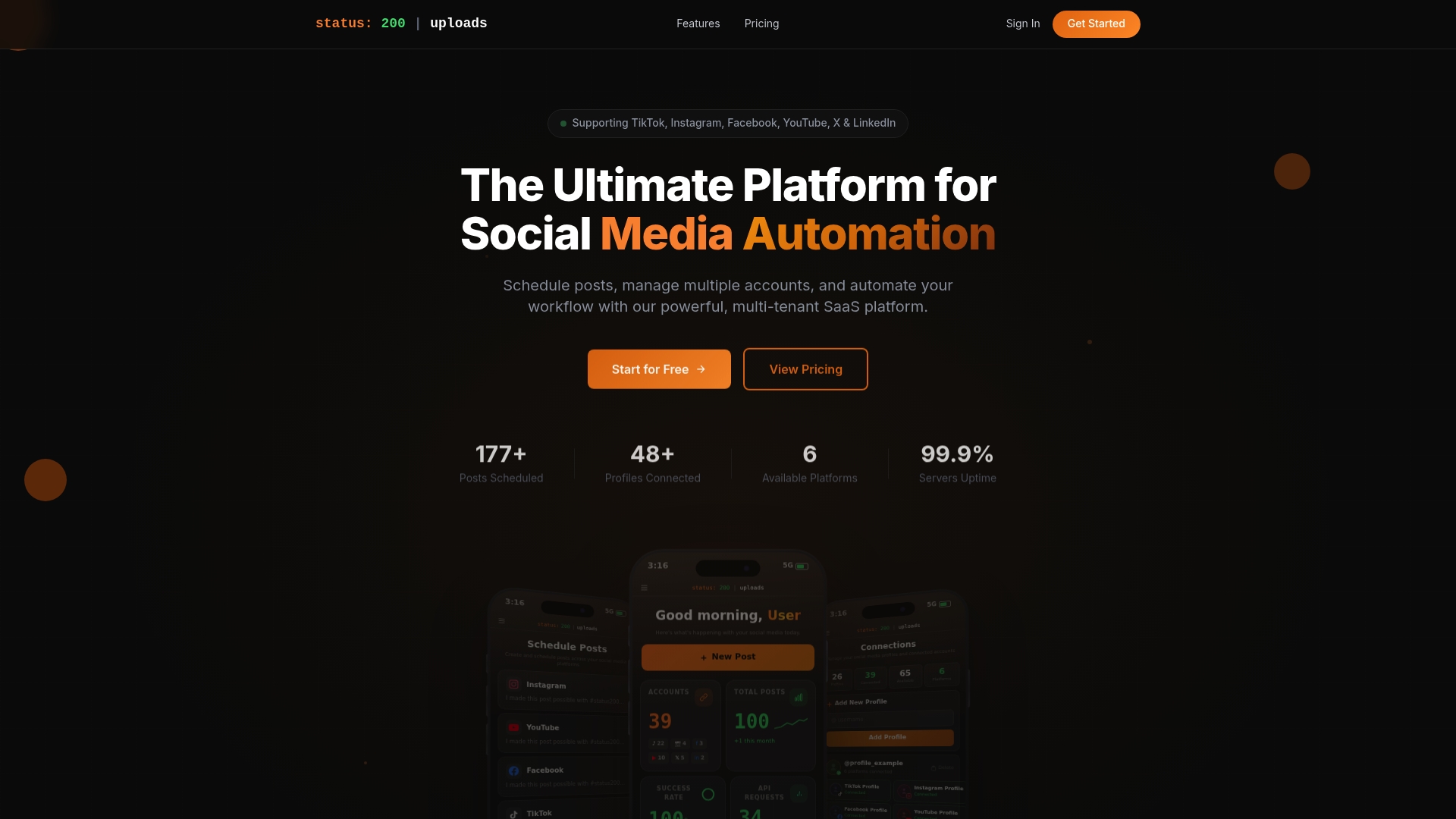
Status 200 Uploads brings together scheduling, multi-account management, media organization, and workflow automation in one dashboard. You can connect TikTok, Instagram, Facebook, YouTube, X, and LinkedIn simultaneously, then plan and publish to all of them without switching tabs or losing track of assets. For teams weighing their options, the Status 200 vs Publer comparison breaks down exactly how the platforms differ on features and pricing. Ready to put everything covered here into action? Schedule posts to all platforms from a single place and start reclaiming the hours your team currently spends on manual publishing tasks.
Frequently asked questions
What is the most efficient workflow for small media teams?
A weekly workflow of planning, batching creation, scheduling, publishing, reviewing, and adjusting enables consistency and measurable improvements without requiring a large team.
Should I post identical content across all platforms?
No. Verbatim cross-posting should be avoided because each platform rewards different formats and tones. Adapt content while keeping your core message consistent.
How do I select meaningful KPIs for social media?
Connect content goals to business outcomes first, then identify only the metrics that reflect objective progress. Follower count rarely qualifies as a meaningful KPI.
What engagement rates should I expect across platforms?
2026 benchmarks vary widely: TikTok runs around 4%, Instagram around 0.5%, and Facebook around 0.15%. Always compare performance within each platform, not across them.
What tools help automate social media content management?
Centralized asset libraries, editorial calendars, and scheduling platforms work together to reduce operational churn and speed up the path from content creation to published post.