Why connect multiple social accounts? Boost efficiency & reach
Learn why connecting multiple social accounts saves 17 hours a week, boosts consistency, and scales your content reach across every platform.
Why connect multiple social accounts? Boost efficiency & reach

The average business now maintains profiles on 6.8 social platforms, and the average person uses nearly as many. That’s not a coincidence. Audiences live across platforms, and brands that show up in only one place leave real reach on the table. But managing that many accounts manually is a recipe for burnout, inconsistency, and missed opportunities. Connecting your social accounts through a unified system isn’t just a trick for big marketing teams. It’s the operational move that lets small teams punch above their weight, keep content flowing, and actually measure what’s working.
Table of Contents
- Core reasons to connect multiple social accounts
- How connected accounts fuel consistent, scalable content
- Deciding what (and where) to connect: Strategy over scatter
- Tool features that matter: What to look for in your social dashboard
- Why bigger isn’t always better: The 80/20 rule for connecting social accounts
- Take control: Schedule, connect, and analyze your social accounts
- Frequently asked questions
Key Takeaways
| Point | Details |
|---|---|
| Efficiency boost | Centralizing social accounts saves hours weekly and cuts manual effort. |
| Consistent branding | Connected accounts help your brand maintain a uniform presence across platforms. |
| Smarter strategy | Not every account should be connected—strategic focus on top platforms gains best results. |
| Feature essentials | Choose tools with scheduling, analytics, and team permissions for seamless management. |
| Tangible results | Adapting content per platform can drive up to 37% higher engagement. |
Core reasons to connect multiple social accounts
If you’ve ever spent a Monday morning logging in and out of five different apps just to post variations of the same update, you already understand the problem. The repetition is exhausting, the risk of errors is high, and the time lost adds up fast. Connecting your social accounts through a centralized dashboard solves this at the root.
The core motivation is simple: centralized account management lets you schedule, publish, and monitor content across every platform from one place. You stop context-switching. You stop forgetting to post on one channel. You stop manually copying captions between tabs. Everything lives in one workflow.
The time savings alone are striking. Unified dashboards cut posting time from 15 to 20 hours per week down to roughly 3 hours, a reduction of 12 to 17 hours weekly. That’s nearly half a workweek handed back to you for strategy, creative work, or community engagement.
Here’s a quick look at the primary benefits of connecting multiple accounts:
- Time savings: Automate repetitive scheduling tasks instead of doing them manually per platform
- Consistency: Maintain a steady posting cadence without relying on memory or manual checklists
- Fewer errors: One source of truth means fewer typos, missed posts, or wrong images going live
- Better data: Unified analytics let you compare performance across platforms side by side
- Team efficiency: Shared dashboards with role-based permissions keep everyone aligned without sharing passwords
Connecting your accounts doesn’t just save time. It creates a system where consistency becomes automatic, not aspirational.
For social media managers handling multiple clients or brands, a centralized management comparison between tools often reveals how much overhead the right platform can eliminate. The goal is fewer logins, more output, and cleaner reporting. That’s what connected accounts deliver. You can schedule posts with Status 200 Uploads to see this in practice across TikTok, Instagram, Facebook, YouTube, X, and LinkedIn from a single dashboard.
How connected accounts fuel consistent, scalable content
Consistency is one of the most cited challenges in social media, and for good reason. 73% of marketers say posting consistently across platforms is their biggest operational hurdle. Audiences expect regular content, and algorithms reward it. Falling behind on one platform can quietly tank your reach while you’re focused elsewhere.

Connecting accounts changes the equation. Instead of treating each platform as a separate project, you treat your content as a single asset that gets adapted and distributed. This is the core mechanic of effective cross-posting: create pillar content, then adapt the format for each channel. A long-form video becomes a TikTok clip, a LinkedIn post, and an Instagram carousel. One idea, multiple touchpoints, far more reach.
Pro Tip: Don’t just copy and paste the same caption everywhere. Adjust the tone and format per platform. LinkedIn readers want context and insight. TikTok audiences want energy and brevity. Adapting takes five extra minutes but can significantly lift engagement.
Here’s how a manual approach compares to a connected strategy:
| Factor | Manual approach | Connected strategy |
|---|---|---|
| Weekly time investment | 15 to 20 hours | 3 to 5 hours |
| Post volume per week | Limited by bandwidth | Scalable with scheduling |
| Content adaptation | Often skipped | Built into the workflow |
| Error risk | High (copy/paste mistakes) | Low (template-based) |
| Analytics | Siloed per platform | Unified and comparable |
The difference isn’t just efficiency. It’s scale. A connected strategy lets a two-person team produce the output of a much larger one. And when your adapting content across platforms workflow is baked into your tooling, it stops being an afterthought and becomes a competitive advantage.
Brands that post consistently also retain more audience trust. The same data shows that 73% of social users will switch to a competitor brand if they receive no response or see irregular activity. Showing up predictably isn’t optional anymore.
Deciding what (and where) to connect: Strategy over scatter
Here’s the trap most people fall into: they connect every account they have, post the same content everywhere, and then wonder why engagement is flat. Being on every platform isn’t a strategy. It’s just noise.
Over-dilution is a real risk when you spread effort across too many channels without audience data to back the decision. The smarter move is to audit where your audience actually lives, commit to those platforms for at least 90 days, and measure before expanding.
Posting frequency also varies significantly by platform. Here’s what the data recommends:
| Platform | Recommended frequency |
|---|---|
| X (Twitter) | 1 to 3 posts per day |
| 3 to 4 posts per week | |
| 3 to 5 posts per week | |
| 3 to 5 posts per week | |
| TikTok | 3 to 5 posts per week |
| YouTube | 1 to 2 videos per week |
Empirical benchmarks like these matter because algorithms favor accounts that post consistently at the right cadence, not accounts that post everywhere all the time.
Use this checklist before connecting a new account to your dashboard:
- Is your target audience active on this platform?
- Do you have content formats that fit this channel’s style?
- Can you maintain the recommended posting frequency without burning out?
- Does this platform align with your business goals (awareness, leads, sales)?
- Do you have the bandwidth to monitor engagement and respond?
Pro Tip: Start with two or three platforms where you already have traction. Master distribution there before expanding. Knowing when to centralize accounts is just as important as knowing how.
Strategic focus beats scattered presence every time. A brand that posts three times a week on two platforms with great content will outperform one that posts sporadically on six.
Tool features that matter: What to look for in your social dashboard
Not all social management platforms are built the same. Choosing the wrong one means paying for features you don’t need while missing the ones you do. Here’s what actually matters when you’re evaluating a tool for connecting and managing multiple accounts.
Platforms like Sprout Social, Buffer, and Hootsuite all support connecting Instagram, Facebook, LinkedIn, TikTok, X, and more. The baseline features are table stakes. What separates good tools from great ones is how they handle the details.
Connecting accounts via management tools eliminates repeated logins, enables bulk scheduling, and surfaces unified analytics. For agencies or anyone managing multiple brands, this is the difference between a manageable workload and a chaotic one.
Here are the must-have features to look for:
- Multi-account integration: Connect accounts across all major platforms in one place
- Visual content calendar: See your entire schedule at a glance, not buried in spreadsheets
- Bulk scheduling: Upload and queue multiple posts at once to save hours
- Platform-specific settings: Control captions, hashtags, and media formats per channel
- Unified analytics: Track reach, engagement, and growth across all accounts in one report
- Team permissions: Assign roles so collaborators can draft or approve without full account access
- API integrations: Connect with tools like Zapier or Make.com to automate your broader workflow
- Media library: Store and organize images and videos for reuse across campaigns
Pro Tip: Before committing to a platform, test how it handles your specific account mix. A tool that works great for Instagram and Facebook but struggles with TikTok scheduling is a half-solution. Look at features for connecting accounts across all the channels you actually use, and check affordable social scheduler options to make sure the value matches the cost.
The right dashboard turns a chaotic multi-platform presence into a clean, repeatable system.
Why bigger isn’t always better: The 80/20 rule for connecting social accounts
Here’s something the social media tool industry doesn’t love to say out loud: connecting more accounts doesn’t automatically mean better results. Most brands see 80% of their engagement driven by just two or three platforms. The rest is noise dressed up as presence.
The instinct to be everywhere is understandable. More platforms feel like more opportunity. But without a focused strategy, connecting every account just means distributing mediocre content more efficiently. That’s not a win.
What actually works is audience-driven prioritization. Find out where your engaged followers live, where conversions actually happen, and where your content format fits naturally. Then connect those accounts, master distribution there, and build from a position of strength.
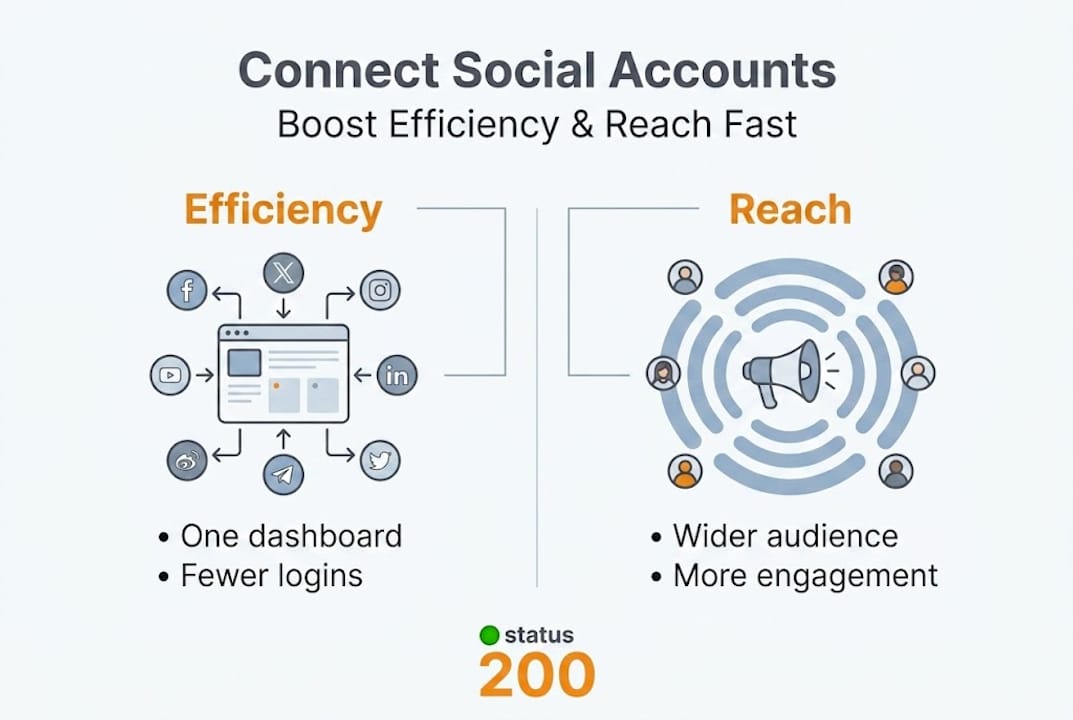
Small teams especially benefit from this approach. Instead of stretching resources thin across six platforms, they can dominate two or three with high-quality, consistent content. The high-return platforms for your business might not be the most popular ones broadly. They’re the ones where your specific audience pays attention.
Platform count is a vanity metric. Engagement quality is the real measure.
Take control: Schedule, connect, and analyze your social accounts
Putting these principles into action starts with having the right tool behind you. Connecting accounts should feel effortless, not like another technical headache.
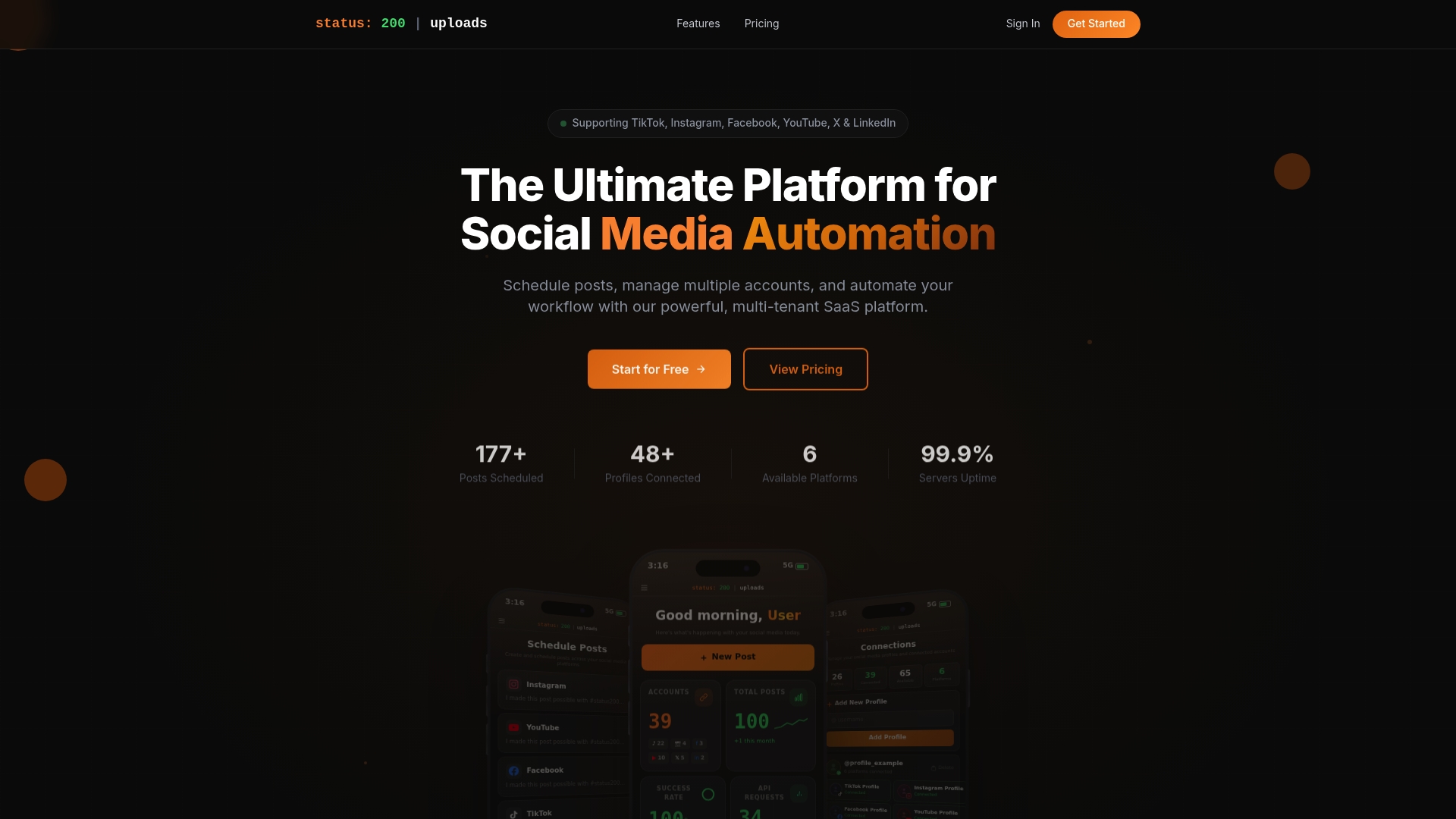
Start connecting accounts with Status 200 Uploads and manage TikTok, Instagram, Facebook, YouTube, X, and LinkedIn from one clean dashboard. Schedule posts in bulk, adapt content per platform, and track performance across every channel without jumping between apps. Whether you’re a solo creator or managing accounts for multiple clients, the workflow is built to scale with you. Check out social scheduler pricing to find a plan that fits your team size and posting volume. The goal is simple: less time managing, more time growing.
Frequently asked questions
What are the main benefits of connecting multiple social accounts?
Connecting accounts saves you 12 to 17 hours weekly through automated scheduling, keeps your posting consistent across platforms, and pulls all your analytics into one place for smarter decisions.
Which platforms can I connect with social management tools?
Most tools let you connect Instagram, Facebook, LinkedIn, TikTok, X, YouTube, and more, all managed from a single dashboard without switching between apps.
How do I avoid spreading too thin when connecting many accounts?
Start with the two or three platforms where your audience is most active, and let audience data guide which accounts you prioritize before expanding further.
Can connecting accounts boost engagement rates?
Yes, particularly when you adapt content for each platform. Tailored cross-posting drives up to 37% higher engagement compared to posting identical content everywhere without any format adjustment.